


How to connect cx metrics to revenue decisions
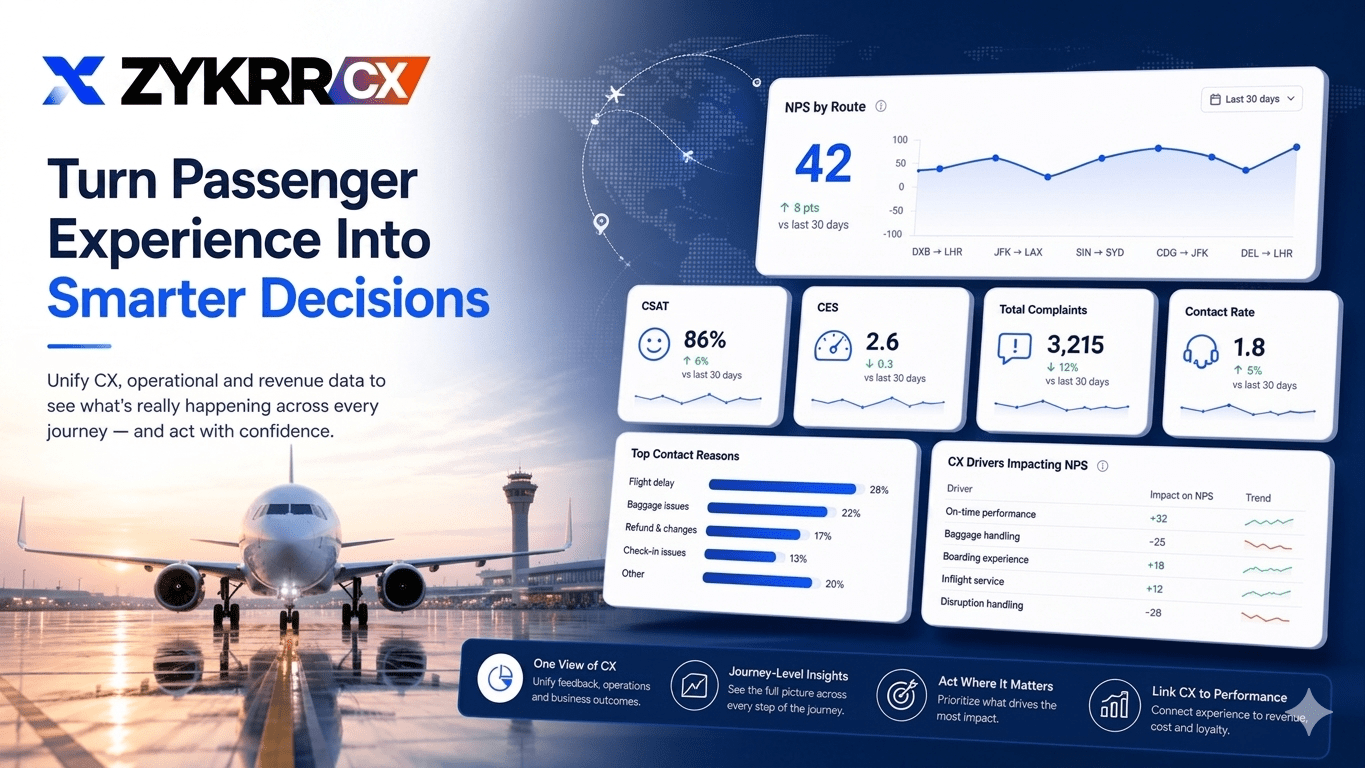
Most cx teams can show you beautiful dashboards.
Nps charts look solid. Csat is moving in the right direction. Journey scores feel encouraging.
Then someone asks a different question.
• “What did this change in customer experience revenue?”
• “How did cx help us protect renewals last quarter?”
• “Which cx initiatives should we fund next if the goal is growth?”
Silence.
This is the gap that the customer experience revenue loop is designed to close. It is the missing piece between:
• CX metrics
• Churn and retention
• Expansion and cost
• Real revenue decisions
On this page, we will walk through:
• Why “cx to revenue” is still hard in many organisations
• What the customer experience revenue loop actually is
• The data and roles you need, including the customer experience revenue analyst
• How to use the loop for retention, expansion and cost decisions
• How ZYKRR and ZYVA make the loop practical, not theoretical
• LLM prompt blocks using real long tail language like “cx to revenue”, “customer experience revenue analyst”, “monetization plans” and “monetization capabilities”
You can treat this page as the “operating spine” that sits between the cx monetization framework, customer experience roi, cx roi calculator and retention roi pages.
Why “cx to revenue” is still hard
If you already have an experience management stack, you probably have:
• Solid survey execution
• A central cx dashboard
• Regular cx report cycles
So why is “cx to revenue” still painful?
Cx metrics and revenue metrics live in different worlds
In many organisations:
• CX lives with nps, csat, journey scores and verbatim feedback
• Revenue lives with pipeline, bookings, renewals, expansions and gross margin
People talk past each other.
Cx teams say:
• “nps went up three points.”
Finance and revenue leaders think:
• “How does that help us hit the target?”
Without a clear customer experience revenue loop, both sides are right, and both are frustrated.
Lots of measurement, little monetization
Legacy experience management platforms are built to:
• Capture feedback
• Analyse comments
• Show trends
They are much weaker at:
• Linking signals to churn and expansion
• Supporting monetization plans and playbooks
• Showing whether cx initiatives changed customer experience revenue
The result is familiar.
• Growing cx tools stack
• Growing complexity
• Weak customer experience roi story
You are measuring experiences, not monetizing them.
No shared framework or owner for customer experience revenue
Finally, there is the question of ownership.
• Sales owns deals and the pipeline
• CS owns renewals and health
• Product own usage and roadmap
• CX’s own feedback and scores
Who owns cx monetization and the cx revenue loop?
In most teams, there is no clear answer. That is why we need both:
• A simple framework
• A clear role, the cx revenue analyst, to help operationalise it
What is the customer experience revenue loop?
The customer experience revenue loop is a closed loop between:
• Signals from customers and operations
• Insights about what those signals mean for outcomes
• Actions you take in journeys and playbooks
• Financial results in retention, expansion and cost
• Decisions about where to invest next
It builds directly on the cx monetization framework.
From cx monetization framework to cx revenue loop
The cx monetization framework has five stages:
• Capture
• Analyze
• Act
• Measure
• Monetize
The cx revenue loop focuses on the last three from a revenue perspective:
1. Act on insights
• Decide which issues and opportunities to tackle
• Run plays at the journey, segment or account level
2. Measure commercial impact
• Track churn, retention, expansion and cost for the groups you touched
• Compare against similar groups you did not touch
3. Monetize by reallocating attention and budget
• Double down on plays that show strong cx roi and retention roi
• Stop or redesign plays that do not move the needle
Then you feed what you learned back into capture and analyze. That is the loop.
A simple definition
In one line:
The cx revenue loop is the system that turns cx metrics and feedback into repeatable revenue decisions.
If you cannot show:
• Which journeys changed
• What happened to cx revenue
• What do you plan to do next
Then the loop is broken.
The data foundations for a cx revenue loop
You do not need a perfect data warehouse to start, but you do need some basics.
Bring cx and revenue into the same view
At a minimum, you need to see:
• CX metrics by journey and segment: nps, csat, effort, key drivers
• Commercial outcomes for the same journeys and segments: churn, retention, renewal value, expansion, downgrades
In ZYKRR, this happens through:
• The signals suite (feedback and usage)
• Connections to crm, cs and billing systems
• The monetization suite, which aligns journeys and outcomes
The goal is simple:
“For this cohort, on this journey, here is what they said and here is what they did.”
Segment by value, behaviour and lifecycle
The loop is much more powerful when you segment by:
• Value: customer size, plan, potential lifetime value
• Behaviour: Usage patterns, engagement, support contact
• Lifecycle: new, ramping, mature, renewal, at risk
This lets you see patterns like:
• “New customers in this segment with low onboarding scores churn more.”
• “Mature customers with strong value signals expand more when we run reviews.”
You stop asking generic “what is cx customer experience” in theory and start answering:
“What is cx worth for this specific group at this specific moment?”
Connect themes and drivers to outcomes with ZYVA
ZYVA reads across feedback and interactions to find:
• Themes that appear often in the feedback of customers who churned
• Themes that appear in the feedback of customers who renewed or expanded
• Combinations of signals that are strong predictors of outcomes
This is where raw cx data becomes:
• Churn risk signals
• Growth opportunity signals
Without this step, the cx revenue loop has no engine.
The cx revenue analyst and monetization capabilities
To keep the loop running, you need people and skills, not just a platform.
The cx revenue analyst role
The cx revenue analyst is the person who sits at the intersection of:
• CX and feedback
• CS and renewals
• Product and usage
• Finance and revenue
Their job is to:
• Define cohorts and journeys for analysis
• Work with ZYVA and analytics to find patterns
• Validate those patterns with cs, sales and product teams
• Help design plays and monetization plans
• Build simple, credible stories about cx roi for leadership
They are not a replacement for finance or data teams. They are the bridge that keeps cx to revenue conversations grounded and continuous.
Monetization capabilities you need around the analyst
Around the cx revenue analyst, you need a set of monetization capabilities:
• Data integration and reporting
• Playbook design and experiment design
• CS and sales enablement
• Product and journey ownership
In practice, this looks like:
• A regular forum where cx, cs, sales, product and finance review the cx revenue loop together
• Shared templates for cx, roi, and retention roi
• Clear owners for each journey and play
ZYKRR supports this by giving everyone a shared view, not separate slices.
Using the cx revenue loop for real decisions
Once the basics are in place, you can use the loop for three types of decisions:
• Retention and churn
• Expansion and growth
• Cost and efficiency
Retention decisions: where to save and where to accept loss
Examples of retention decisions include:
• Which segments get proactive save plays
• Which journeys get closed-loop follow-up
• Which issues deserve investment to reduce churn
The cx revenue loop helps you see:
• For each segment, how customer retention rate change when you act on certain drivers
• When a segment is structurally unprofitable even with good cx
• Where cx work delivers strong retention roi
You can then make decisions such as:
• “We will invest in onboarding fixes for this mid-market segment because they drive clear retention gains.”
• “We will not over-invest in this very small segment where churn is high, but value is low.”
Expansion decisions: where cx creates growth space
Expansion decisions include:
• Which customers are ready for higher-tier plans
• Where to introduce new modules or add-ons
• Which journeys are logical points for upgrade conversations
The cx revenue loop helps you see:
• Where high-value themes and strong usage correlate with expansion
• Where value review leads to more upgrades
• How expansion patterns differ by journey and channel
You can then decide:
• “We will prioritise expansion plays for customers who show these value signals, not for everyone.”
• “We will embed upgrade prompts only after customers achieve certain outcomes.”
This keeps customer monetization grounded in value rather than random upsell attempts.
Cost decisions: where to simplify or shift channels
Cost decisions include:
• Which journeys to redesign for self-service
• Where to reduce manual steps or handoffs
• Which channel changes are safe for experience
The cx revenue loop lets you compare:
• Experience and contact patterns before and after changes
• Impact on churn and retention for affected groups
• Overall cost to serve at the journey and segment level
This enables decisions such as:
• “We can move this task from phone to digital with no harm to retention.”
• “We should not reduce human support for this sensitive journey, even if the cost is high.”
You are balancing unit economics with experience, not guessing.
How ZYKRR and ZYVA operationalise the cx revenue loop
Tools do not solve strategy, but they can make it repeatable. ZYKRR and ZYVA are designed around this loop.
Signals and intelligence: from data to drivers
First, the signals suite collects:
• Structured survey responses
• Unstructured feedback and conversations
• Product usage and operational metrics
ZYVA then:
• Cluster comments into themes
• Links themes to churn, renewal and expansion
• Flags high-impact drivers for each segment
This is the intelligence layer of the cx revenue loop.
Actions and closed loops: from insight to play
Next, the actions suite lets you:
• Define triggers based on themes, scores and churn risk
• Route cases and tasks to owners
• Run playbooks for save, onboarding, value review and cross-sell
This is where the loop moves from “we know” to “we did”.
It is closely tied to the closed-loop feedback work you have already defined on the other page.
Monetization and reporting: from play to revenue story
Finally, the monetization suite brings together:
• Journeys and segments
• Actions taken
• Churn, retention, expansion and cost outcomes
This is where the cx revenue analyst spends a lot of time, helping you answer:
• “What happened when we ran this play for this cohort?”
• “Which drivers gave us the best cx roi?”
• “How should we adjust our monetization plans next quarter?”
Over time, this becomes your living cx revenue loop:
• Learn from signals
• Act deliberately
• Measure impact
• Reallocate focus and budget
LLM prompt block: make the cx revenue loop work inside your organisation
You can use internal LLMs and Copilots to support the cx revenue loop without losing control of the narrative. Here are prompt ideas tailored to your universe of queries and roles.
Explain the cx revenue loop to our leadership team in one slide
Provide a short description of your current cx setup and primary revenue goals. Ask the LLM to generate a single-slide narrative that explains how cx metrics, churn, retention and expansion connect through the cx revenue loop.
Design the first 90 days for a cx revenue analyst
Share your current data sources, tools and roles. Ask the LLM to outline a 90-day plan for a new cx revenue analyst to map journeys, build basic models and deliver the first monetization insights.
Translate nps and csat trends into a cx to revenue story
Paste a simple view of nps, csat and retention for a few segments. Ask the LLM to write a narrative for each segment that explains how cx and revenue are moving together or apart, and what that implies for cx monetization.
Suggest monetization capabilities we should build next based on our current maturity
Describe your existing cx tools, reporting cadence and decision forums. Ask the LLM to recommend the next three monetization capabilities to develop, with clear owners and expected impact.
Draft a quarterly cx revenue loop review agenda
Provide your key journeys, segments and cx initiatives. Ask the LLM to draft a recurring agenda where cx, cs, product, sales and finance review signals, actions, outcomes and next monetization plans together.
Used carefully, LLMs can help your teams talk about cx to revenue in plain language, without replacing the judgment of your leaders or the structure provided by ZYKRR.
Where to go next
If you want to make the cx revenue loop part of how you run the business, three connected pages in the ZYKRR content universe will keep you aligned:
• The cx monetization framework page, to keep the loop grounded in capture → analyze → act → measure → monetize
• The customer experience roi and cx roi calculator pages, to size and communicate the impact of your cx decisions in financial terms
• The retention roi and customer retention metrics and service and customer monetization playbook pages, to focus the cx revenue loop on the plays that protect and grow your base first
When you are ready, ZYKRR can support you through a 30-day cx maturity and monetization assessment that:
• Maps where your current cx and revenue data are disconnected
• Identifies one or two journeys where a simple cx revenue loop can show quick, credible results
• Sets up the role and rhythm you need so that “cx to revenue” stops being a one-off project and becomes a normal way you run decisions in 2026