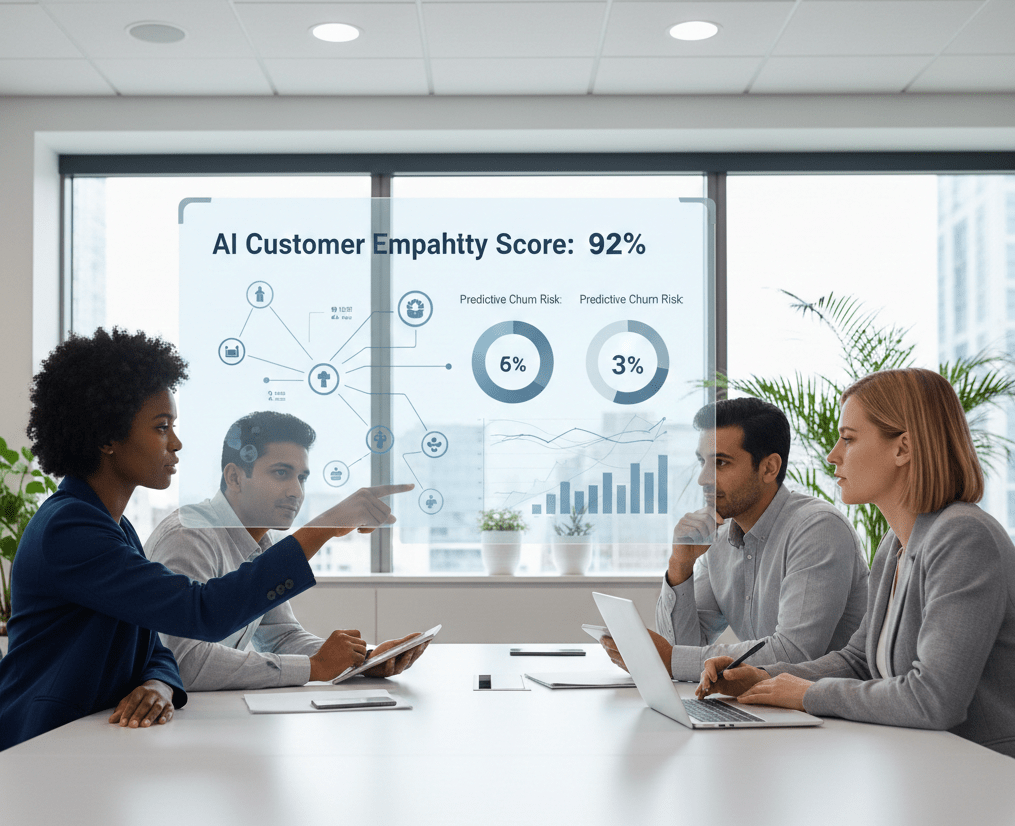



AI in customer service agents that customers actually trust
Most customers have met bad bots.
They repeat the same questions.
They do not understand simple requests.
They trap people in loops with no way to reach a human.
So when leaders talk about deploying an AI in customer service agent in 2026, frontline teams and customers are understandably wary.
The potential is real:
• Faster answers for simple tasks
• Lower wait times in peak periods
• More consistent service across channels
The risk is also real:
• Frustrated customers who churn faster
• Higher contact volume as people “escape the bot”
• Brand damage when AI feels cold or careless
This page is about how to design AI in customer service agents and chatbots that customers actually trust.
We will walk through:
• Where AI in customer service agents fit in the customer experience journey.
• Which use cases work well for AI, and which should stay with humans?
• How to design bot flows that feel human and helpful, not robotic.
• How to measure impact on cx, retention and cx monetization.
• How ZYKRR and ZYVA connect AI in customer service agent to feedback, journeys and revenue.
• LLM prompt patterns you can use to explore “how AI chatbots improve customer experience” and “using AI for customer experience” in your own context.
You can treat this as the service and support companion to the AI in customer experience pillar, the feedback analysis cluster and the cx monetization framework.
Where AI agents fit in the customer experience journey
Before building bots, it helps to answer a simple question:
For which journeys do customers genuinely prefer a fast automated interaction, and where do they need a human?
Journeys that are good candidates for AI in customer service agents
These are usually:
• Frequent
• Structured
• Low to medium emotional intensity
Examples:
• Password reset and account access issues
• Checking order, application or claim status
• Updating basic details (email, address, card)
• Simple billing questions (next due date, last payment)
• Basic product “how do I” queries with clear answers
Here, using AI for customer experience is straightforward. Customers want:
• Quick resolution
• No long queues
• Clear confirmation
An AI agent that can handle these tasks end-to-end reduces effort and cost at the same time.
Journeys that should stay human-first
On the other hand, journeys that are:
• Emotionally charged
• High value or high risk
• Ambiguous and open-ended
Should remain human-led.
Examples:
• Serious complaints or service failures
• Claim disputes in insurance
• Life-changing financial decisions
• Complex B2B escalations or renegotiations
AI still has a role here, but it is a support role:
• Preparing context for human agents
• Surfacing relevant policies and next steps
• Summarising previous interactions
This is where the role of AI in customer service is to amplify humans, not replace them.
What “good” looks like for AI in customer service agents
When people ask “how AI chatbots improve customer experience”, they often imagine a magical assistant that can do everything.
In reality, good AI in customer service agents shares a few grounded qualities.
Clear about what they can and cannot do
A trustworthy AI agent:
• Introduces itself plainly (“I am an AI assistant from ZYKRR’s support team”)
• States what it can help with (“I can help you with account questions, basic troubleshooting and status updates”)
• Offers a clear path to a human when needed
This builds trust quickly.
Fast on simple tasks, humble on complex ones
Good AI in customer service agents:
• Complete simple, repetitive tasks quickly
• Ask a few focused questions, not endless forms
• Show when they are unsure and escalate gracefully
They are designed around completion, not conversation for its own sake.
Grounded in real data and context
The best AI in customer service agents do not answer in isolation. They are connected to:
• Account and product data
• Recent interactions and cases
• Current incidents and outages
So when a customer asks:
• “Why am I seeing this charge?”
• “What is happening with my claim?”
The agent can respond based on context, not generic FAQ text.
ZYKRR and ZYVA help here by unifying signals and journeys, so AI agents see the same picture your human agents see.
Designing AI flows that customers actually like
Designing a good AI agent is less about clever prompts and more about journey design.
Start with tasks, not technology
Rather than asking “What can AI do?”, ask:
What jobs are our customers trying to get done when they contact us?
For each job:
• Write a plain-language description of what the customer wants
• Map the current steps they have to take
• Highlight pain points: wait time, repetition, confusion
Then decide:
• Which steps could the AI agent handle
• Which steps must stay with humans
• At which points the agent should offer escalation
This is where “strategies for leveraging AI in the customer experience” become concrete.
Use structured flows as scaffolding, not a cage
LLM-powered agents can respond flexibly, but they still need structure.
Good patterns include:
• Short, guided flows for common tasks
• Open text handling within those flows (“tell me what happened in your own words”)
• Simple buttons and options for clarity
For example, an AI agent might say:
• “I can help you with billing, technical issues or account updates. Which one fits best?”
• After the choice, it can ask a free-form question to capture detail, then decide the next best step.
Design for handoff from the start
One of the biggest sources of frustration is when bots refuse to hand over.
Good design includes:
• Clear triggers to offer human help
– Repeated “I do not understand” moments
– The customer explicitly asking for a person
– Detection of sensitive topics
• Clean transfer with context
– The human sees what was already discussed
– The customer does not have to repeat everything
Combined with emotion AI and behavioural signals, this is how AI agents become part of an empathetic service experience.
How to measure AI agent impact on cx and revenue
In 2026, launching an AI agent without a clear measurement plan is risky. You need to know:
• Whether it is actually helping customers
• Whether it is improving or hurting cx monetization
CX and effort metrics
Track experience with and around the AI agent:
• Post-interaction csat or effort scores
• Containment rate for tasks meant to be fully automated
• Bounce-out patterns (how often customers leave the bot and call anyway)
• Qualitative feedback on clarity and helpfulness
These answer “how AI is changing customer experience” at the surface level.
Operational and cost metrics
Measure operational impact:
• Changes in average handle time for human agents
• Shifts in contact volume across channels
• Time to first response in critical queues
These show how AI agents affect your service unit economics.
Revenue and retention metrics
To connect AI agents to cx monetization:
• Compare churn, retention and expansion for cohorts heavily using AI support vs those who do not
• Track how AI-driven resolution on early issues affects onboarding outcomes
• Monitor whether negative bot experiences correlate with higher churn risk
With ZYKRR, the monetization suite helps you see:
• Where AI agents are pulling their weight on CX ROI
• Where they are quietly destroying value despite good containment numbers
This turns “the future of AI in customer experience” into a grounded, data-backed story.
How ZYKRR and ZYVA support AI customer service agent
ZYKRR is not itself a bot framework, but it is the intelligence and monetization layer that makes AI agents effective and accountable.
Signals and context for AI agents
Through the signals suite, ZYKRR collects:
• Feedback from customers about their support experiences
• Transcripts and outcomes from existing bot and agent conversations
• Journey tags and segments for each interaction
This data can be fed into your AI agent platform so that:
• The agent sees journey, segment and recent events
• Design teams can analyse where bots work and where they fail
ZYVA as the brain behind improvement
ZYVA, the AI feedback intelligence engine, helps you:
• Analyse bot conversations at scale
• Detect themes where customers get stuck or frustrated
• Identify intents that bots should handle but are failing on
• Spot where how AI chatbots improve customer experience is working vs where it needs redesign
For example:
• “Customers frequently express confusion about this policy when interacting with the bot; handoff happens late and frustration is high.”
• “Simple billing queries are resolved quickly and receive high satisfaction via the bot; we can safely route more of this traffic there.”
Closing the loop and monetizing AI agent performance
Finally, by connecting AI agent data into the actions and monetization suites, ZYKRR lets you:
• Trigger follow-up for customers who had a poor bot experience
• Run experiments on bot flows and measure impacts on churn and retention
• Prioritise bot improvements that have the strongest impact on cx revenue
You are not just “using AI for customer experience” in the abstract. You are running AI agents as part of a disciplined cx revenue loop.
Practical guardrails for AI agents in 2026
To keep AI agents aligned with your brand and customers, a few simple guardrails help.
Human override is always available
Customers should always have:
• A visible way to request a human
• Clarity when a human will be available (now, scheduled callback, email)
This is basic respect and reduces the risk of AI overreach.
Sensitive topics are handled with extra care
Define clear rules for topics that:
• Must always be escalated (safety, harassment, legal threats)
• Require explicit human review before certain actions are taken
AI can help detect these topics quickly, but should not act alone.
Transparency and tone
Make it clear when customers are talking to AI vs a human. Do not pretend.
Tune tone so that AI is:
• Simple, direct and respectful
• Aligned with your brand voice
Free from fake empathy and over-familiarity
Badly tuned “friendly bots” often feel more annoying than neutral ones.
LLM prompt block: exploring AI customer service agents in your environment
Here are llm prompt patterns you can use inside your own copilot or AI workspace. They tie to long-tail interests like “how AI can improve customer experience”, “how AI enhances customer experience and engagement” and “using AI for customer experience” with real tasks.
Map AI agent opportunities across our journeys
We serve [describe customers, industry]. list our main support journeys and show where an “ai customer service agent” could handle the interaction end-to-end, where it should only assist humans, and where it should not be used at all. explain why for each case.
Design a minimal viable AI chatbot that customers will not hate
We want to launch a simple ai chatbot focused only on [two or three tasks, for example, order status and basic billing]. design the conversation flows, escalation rules and guardrails so that it improves customer experience instead of frustrating people.
Review our current bot transcripts and suggest improvements
Here are anonymised chat transcripts from our existing bot [paste sample]. act as an “ai feedback analysis” engine. identify common failure patterns, confusing responses and moments where the bot should have escalated earlier. suggest three changes that would make the experience better.
Help us explain AI agents to our frontline teams
Write a short internal note to our customer service agents explaining “how AI chatbots improve customer experience” when designed well, and clarifying that ai is here to handle repetitive work and support them, not replace them. include two examples relevant to our context.
Define metrics and targets for our AI customer service agent
We plan to launch an “ai customer service agent” for [use cases]. propose a simple metric framework for cx, operations and revenue. include targets for the first six months and show how we can detect if the bot is harming cx or retention.
Used this way, llms help you think through design, governance and measurement for AI agents, not just generate scripts.
Where to go next
If AI customer service agents are the visible face of AI in customer experience, the deeper layers sit in related pages such as:
• AI feedback analysis and text analytics in customer experience: To understand the signals that should shape bot design and improvements.
• Emotion AI and behavioural signals in customer experience: To decide when AI should persist, when it should pause, and when it must escalate.
• Predictive cx analytics for churn, retention and expansion: To connect AI service experiences directly into your churn and retention models.
Together with the cx monetization pillar, these pages give you a full view of how AI agents move from being a cost-cutting experiment to a disciplined, measurable part of your cx revenue engine in 2026.