


Why NPS and CSAT
Need a Redesign in 2026
For most companies, NPS and CSAT are already in place.
• NPS survey once or twice a year
• CSAT after tickets and key interactions
• Dashboards from NPS tools or customer survey software
You can answer basic questions:
• What is our NPS?
• What is our CSAT score?
• How many responses did we get?
In 2026, that is not enough.
Leaders want to know:
• Where should we improve the experience first?
• How are nps and csat linked to churn, retention and expansion?
• How often should we ask for feedback so customers do not burn out?
This page is a practical guide to designing nps and csat programs that:
• Customers actually answer
• Teams actually use
• Leadership can connect to cx monetization
It assumes you already know the textbook answers to “what is NPS” and “what is CSAT”. The focus here is on how to run these programs in a modern, AI-enabled stack with ZYKRR and ZYVA in the background.
Quick reset: What is CSAT, what is a CSAT score, and what is the CSAT range
A fast refresher in plain language.
What is CSAT?
Customer satisfaction (csat) is usually a simple question like:
“How satisfied were you with your recent [interaction or experience]?”
Customers respond on a short scale, often:
• 1 to 5
• 1 to 7
• 1 to 10
You then calculate:
The percentage of respondents who chose the “satisfied” or “very satisfied” options and track it as your csat score
What is a CSAT score and CSAT range
In practice:
• A CSAT score is a percentage, often between 60 and 95 percent for healthy operations.
• The csat range gives you context: are you usually between 75 and 85, or between 50 and 70.
You do not need to chase a universal magic number. Focus on:
• Segment by segment
• Journey by journey
• Month-over-month trend
And how csat relates to retention and revenue in your world.
How to calculate csat scores in practice
To calculate csat:
• Decide which responses count as “satisfied”
• Divide the number of “satisfied” responses by the total responses
• Multiply by 100 to get a percentage
ZYKRR can calculate this in real time across journeys, segments and channels, so csat is always viewed in context, not as a single global number.
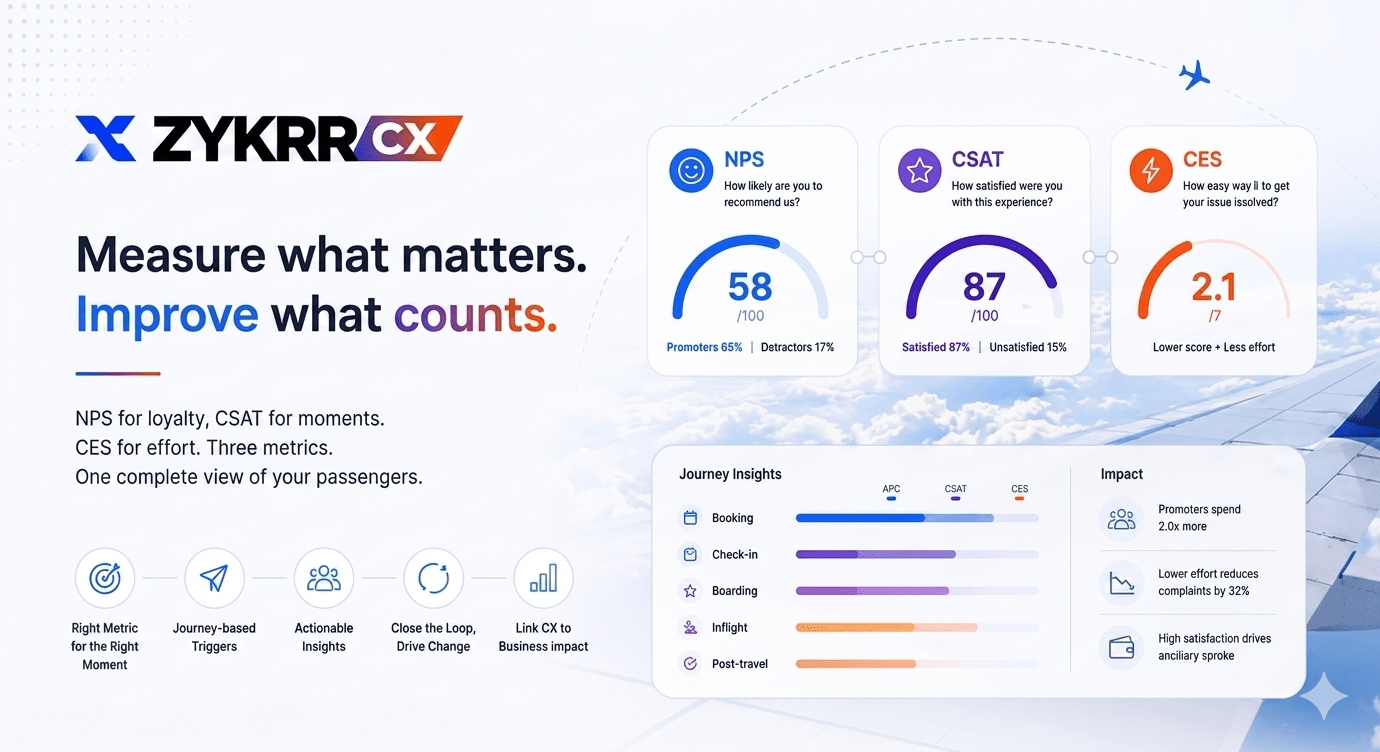
NPS vs CSAT: When to use what
People search for terms like nps csat tools, nps program, what is csat in customer service, what is csat customer satisfaction, because they are trying to answer one question:
When should I use NPS, when should I use CSAT, and when do I need both?
NPS: relationship health and advocacy
Use NPS when you want to know:
• How likely are customers to recommend you?
• How does the overall relationship feel?
• How is loyalty moving over time?
Typical patterns:
• A relationship NPS survey is conducted two to four times a year
• Sometimes a journey nps after critical milestones, such as onboarding
It is not tied to one specific interaction. It is about the whole relationship.
CSAT: Experience quality in key moments
Use csat when you need to understand:
• How a specific interaction felt
• How a particular channel or team is performing
Examples:
• After a support ticket is resolved
• After an onboarding call
• After a purchase or claim submission
Using both together
A simple way to think about it:
• NPS tells you “do they want to stay and recommend”
• CSAT tells you “how did this specific step feel?”
In ZYKRR:
• NPS and CSAT are both captured as signals
• ZYVA helps you link both to churn, retention and expansion
• The CX monetization layer shows which journeys and drivers matter most
Step 1: Map journeys and decide where to ask
Design your program around journeys, not channels.
Identify your critical journeys
Common examples:
• Onboarding for new customers
• Using the core product or service
• Getting support or service help
• Billing, renewals and claims
• Cancellation or downgrade
For each journey, ask:
• What is the customer trying to accomplish?
• What could make this journey feel easy or painful?
• How does this journey affect churn, retention or expansion?
Place nps and csat at the right moments
A useful pattern:
• Use NPS for:
Overall, the relationship is a few times a year
Key lifecycle milestones, such as after 30–60 days for new customers
• use CSAT for:
Support tickets and chats
Onboarding sessions or go-live
Important transactions such as claims, applications, orders
ZYKRR allows you to tag each response by journey and touchpoint, so you can later answer:
• “What is the customer retention rate for customers with low csat in onboarding versus those with high csat”
• “How does nps differ between customers who had multiple complaints and those who did not?”
Step 2: Choose questions and scales that customers actually understand
Too many programs copy generic surveys and wonder why response rates and data quality are weak.
Keep the core questions simple
For CSAT:
• One main satisfaction question
• One or two optional diagnostic questions
• A single open-text question for “why”
For nps:
• The standard recommends a question
• An open-text “What is the main reason for your score?”
Avoid:
• Long grids
• Jargon in questions
• Multiple rating scales in one short survey
Align wording with your brand and context
Instead of generic wording, tune questions to sound like you, for example:
• “How easy was it to get this done today?”
• “Did we resolve your issue fully?”
• “How confident do you feel using [product] after this interaction?”
ZYKRR supports different templates by journey and segment, so feedback feels less robotic and more relevant.
Step 3: Decide who to ask and how often
Search phrases like how often to send NPS survey, NPS program, is CSAT easy, is csat tough, all circle around frequency and scope.
Avoid feedback fatigue
Principles:
• A given customer should not get a survey after every tiny interaction
• Avoid sending both csat and nps in a short window unless there is a clear reason
• Adjust frequency by segment and value
Practical starting points:
• Relationship nps: two to four times a year per customer
• Transactional csat:
After key journeys
With limits such as “no more than one csat request per customer per week”
ZYKRR’s signals layer can enforce frequency caps and segment-specific rules so you do not over-survey your most valuable customers.
Sample smart, not just wide
You do not need every customer to answer every survey.
You do need:
• Enough responses per journey and segment to see patterns
• Representative coverage across regions and segments
ZYKRR can:
• Manage random sampling rules
• Oversample strategic segments when needed
• Track who was invited, who responded and who opted out
Step 4: Choose the right channels for your audience
Even the best-designed question fails if it shows up in the wrong place.
Common csat and nps channels
• In-app or in-product prompts
• SMS or messaging
• Web intercepts after journeys
Think about:
• Where do your customers already interact with you?
• Which channels feel natural for feedback?
• Which channels can your systems support reliably?
ZYKRR supports multi-channel capture, so you can mix:
• Email for relationship nps
• In-app prompts for product csat
• SMS for certain high-sensitivity journeys where email response is low
Step 5: Connect scores to comments, behaviour and outcomes
This is where most programs fall down.
They calculate:
• NPS scores
• CSAT scores
• Maybe some basic filters
and stop.
Link scores to open-text feedback
Use open-text to answer:
• Why did promoters give high scores?
• What do detractors complain about most?
• Which phrases and issues show up right before churn?
With ZYVA, ZYKRR runs AI feedback analysis and text analytics on:
• NPS comments
• CSAT comments
• Ticket and chat transcripts
To extract:
• Themes
• Drivers
• Sentiment and emotion
Link scores and drivers to churn and retention
Pair feedback with:
• Customer retention rate by cohort
• Churn and downgrade events
• Expansion and upsell events
You can then answer:
• “What is customer retention for customers with high onboarding csat versus low csat?”
• “Which csat drivers are most predictive of churn?”
• “Which nps themes are common among customers who expand?”
This moves you from “what is csat” to “what is the retention value of improving csat on this driver for this segment.”
Step 6: Define ownership and routines for acting on NPS and CSAT
Tools alone do not create a customer feedback program. People and routines do.
Assign clear owners
Examples:
• CX leader owns program design and quality
• Journey owners (product, operations, service) own drivers in their journeys
• CS and sales own relationship follow-up for at-risk accounts
Make it clear:
• Who reads which feedback?
• Who makes which decisions?
• How often do you review and adjust?
Build regular feedback forums
Set up:
• Monthly or quarterly feedback review for each key journey
• A cross-functional forum to discuss themes, not just scores
• A simple process to move from “insight” to “experiment” to “change”
ZYKRR and ZYVA can provide:
• Journey and segment dashboards
• Driver analysis
• Narrative summaries for each review meeting
How ZYKRR and ZYVA support modern NPS and CSAT programs
ZYKRR and ZYVA are designed to treat NPS and CSAT as inputs to CX monetization, not just reporting.
Signals: flexible NPS and CSAT capture
• Relational and transactional nps
• CSAT for key touchpoints
• Custom micro-feedback where needed
• Multi-channel send and capture
Intelligence: feedback analysis and driver discovery
ZYVA:
• Analyses open-text comments from nps and csat
• Detects themes, sentiment and emotion
• Links drivers to churn, retention and expansion
• Distinguishes noise from signals that matter commercially
Actions: close loops and design plays
From ZYVA insights, ZYKRR can:
• Trigger tickets or tasks for detractors and critical csat responses
• Prioritise outreach for at-risk high-value customers
• Feed improvement ideas into product and journey backlogs
Monetization: nps and csat as part of the cx revenue loop
The monetization layer:
• Shows how changes in drivers affect churn and retention
• Supports a customer experience roi or cx roi calculator view
• Let’s help you build a clear story for leadership:
“We changed this part of the journey based on nps and csat feedback, and now retention is here, and revenue impact is here.”
LLM prompt block: Designing your NPS and CSAT program with a copilot
You can use your own LLM or Copilot (and ZYVA) to design and refine your program. Here are prompt patterns tuned to your keyword universe.
Audit our existing NPS and CSAT setup
Here is how we currently run nps and csat [paste details]. Act like a cx consultant. Identify weaknesses in survey design, frequency, tooling and closed-loop follow-up. Suggest specific changes to move us from measurement to cx monetization.
Design journey-based NPS and CSAT placement
We have these key journeys [list]. For each journey, recommend whether we should use nps, csat or both, which channel to use, and how often to ask. Keep customer fatigue in mind and justify each choice.
Rewrite our nps and csat questions in plain language
Here are our current nps and csat questions [paste]. Rewrite them in simple, human language that matches a modern b2b or b2c brand voice. Keep the scales consistent and easy to understand.
Connect our nps and csat data to retention
We have historic nps scores, csat scores, churn data and retention data [describe at a high level]. Propose an analysis plan that will show which feedback drivers and scores are most strongly linked to retention and expansion.
Explain nps and csat to non-CX stakeholders
Write a short note that explains “what is CSAT”, “what is a csat score”, and “how csat and nps fit into our cx revenue loop” for non-CX colleagues. emphasise why scores alone are not enough and why we are redesigning our program.
Used this way, LLMs are a strategy partner for your feedback design, while ZYKRR and ZYVA are the operational backbone.