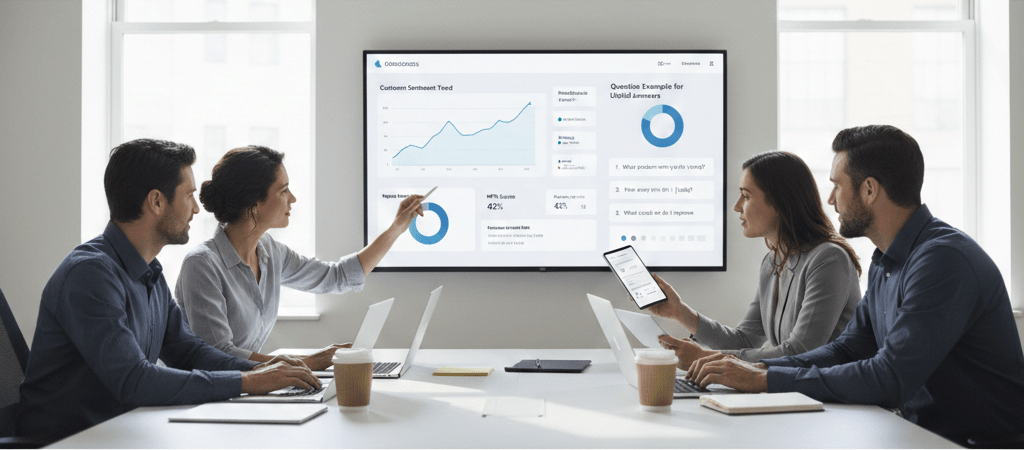



Customer Feedback Analysis and Dashboards
From Tags to Insight
Most teams already have some version of customer feedback analysis and dashboards.
• NPS and CSAT scores on a slide
• A wall of tags from customer feedback analysis tools
• Charts from a customer feedback database
You can see:
• Top words in comments
• Average scores by channel
• Sometimes, a customer feedback score per segment
Yet the conversations sound like this:
• “We have tonnes of feedback, but do not know what to fix first.”
• “Our dashboard is beautiful, but product and sales do not use it.”
• “We cannot show the impact of feedback on churn and retention.”
This page is a practical guide to customer feedback analysis and dashboards that:
• Go beyond tags and word clouds
• Surface drivers, not just topics
• Connect feedback to churn, retention and cx monetization
We will cover:
• What is customer feedback analysis really in 2026?
• The difference between tags, themes and drivers
• How to choose and use customer feedback analysis software and feedback analytics?
• How to design dashboards for cx, product, cs and leadership?
• How to bring in customer feedback ux, complaints, reviews and “feedback about software” into one view?
• How ZYKRR and ZYVA turn fragmented feedback into decisions and plays?
What customer feedback analysis is (and is not)?
Searches like customer feedback analysis tools, customer feedback analysis software, feedback analytics, customer feedback database usually assume analysis means:
• Counting keywords
• Tallying sentiment
• Plotting charts
Those are useful, but incomplete.
• In practice, customer feedback analysis in 2026 should answer three questions:
• What are customers telling us, across channels and journeys
• Which themes and issues are actually driving satisfaction, churn and retention
• What should we change, in what order, for which segments
If your current analysis cannot answer those, you have data, not insight.
From tags to themes to drivers
A lot of dashboards stop at tags. ZYKRR and ZYVA are built to keep going.
Tags: the raw ingredients
Tags are:
• Words or short phrases attached to feedback
• Often created by basic text analytics or manual coding
Examples:
• “Price”
• “Onboarding”
• “Support response time”
• “Mobile app”
Tags tell you what people talk about. They do not tell you why it matters.
Themes: grouped meaning
Themes are:
• Clusters of related tags
• Broader patterns that describe an experience dimension
Examples:
• “Clarity of communication”
• “Ease of getting started”
• “Perceived value for money”
• “Stability and performance”
Themes are already more helpful, especially when you view them by journey and segment.
Drivers: what moves behaviour and money
Drivers are:
• Themes that show a strong relationship with behaviour and outcomes
• The “levers” that change churn, retention, expansion or referrals
Examples:
• “Confusing onboarding instructions” as a driver of early churn
• “Fast and decisive support” as a driver of expansion and advocacy
• “Billing mistakes” as a driver of complaints and downgrades
This is where ZYVA’s feedback analytics and AI capabilities matter. ZYVA:
• Reads comments, tickets and chats
• Identifies themes and emotions
• Links them to churn, retention and revenue data in ZYKRR
You move from:
“People mention price a lot”
to:
“For mid-market SaaS customers, unclear pricing explanations and surprise charges are a top driver of churn in the first six months.”
The raw material: where feedback lives
Before analysis, you need a realistic inventory of feedback sources.
Structured feedback
• NPS and CSAT surveys
• Customer feedback forms and micro-surveys
• Customer satisfaction in software testing and customer satisfaction in software engineering surveys inside dev and qa processes
• In-product ratings
These usually live in:
• A customer feedback database
• Your customer survey software or customer feedback platform
Semi-structured and unstructured feedback
• Open-text comments in surveys
• Support tickets and email threads
• Chat transcripts and call notes
• Reviews and feedback about software on public sites
• Internal notes from cs, sales and product teams
These often sit in:
• Helpdesk tools
• CRM
• Review management tools
• Shared documents and sheets
Complaints and issues
• Formal complaints in customer complaint software or customer complaint management software
• Escalations and regulatory tickets
From a cx monetization perspective, you want all three buckets:
• Structured scores
• Unstructured comments and conversations
• Complaints and escalations
Flowing into one analytical view.
ZYKRR’s signals layer is built to unify these sources and keep them tagged by journey, segment and channel.
Customer feedback analysis tools and software: What they need to do now
There are many products that call themselves customer feedback analysis tools or customer feedback analysis software.
To stay useful in 2026, they need to do more than count phrases.
Baseline expectations
At a minimum, your analysis layer should:
• Ingest multiple sources of feedback, not just surveys
• Support filtering by segment, product, region and journey
• Provide sentiment analysis by theme and channel
• Support timelines so you can see how themes move over time
Ask:
• Can this system handle customer feedback ux signals from digital journeys?
• Can it separate customer feedback from customer complaints and still analyse both together?
Advanced expectations
An analysis layer that is ready for cx monetization should:
• Automatically identify themes and candidate drivers
• Flag emerging issues early
• Link themes to churn, retention and expansion cohorts
• Handle feedback vs review consistently
• Support deeper AI, such as AI feedback analysis and text analytics
This is exactly what ZYVA is designed to do inside ZYKRR:
• Read the messy text
• Understand the patterns
• Quantify which ones actually affect behaviour and money
Designing feedback dashboards that people actually use
Dashboards are where analysis meets decision-making. Many customer feedback dashboards fail because they are designed as reporting artefacts, not decision tools.
Built by the audience, not just by the data source
Think in four audience views:
1. CX and CS leaders
• Need to see the health by journey and segment
• Need early warning on issues
• Need to coordinate closed-loop actions
2. Product and UX teams
• Need to see customer feedback ux patterns
• Need before/after views when changes go live
• Need evidence for prioritising improvements
3. Commercial teams (sales, csms, marketing)
• Need to understand what customers are thinking in specific accounts
• Need signals that affect renewal and expansion conversations
Executives and finance
• Need a short story on how feedback relates to churn, retention and revenue
Each audience should have:
• A small number of views
• Consistent definitions
• Clear links to decisions they own
ZYKRR supports role-based dashboards so each group sees what matters to them.
Core dashboard patterns that work
Rather than dozens of pages, you can accomplish a lot with a few standard patterns.
1. Journey health overview
For each key journey (onboarding, support, billing, renewal):
• NPS and CSAT trends
• Top themes and drivers
• Volume of complaints and escalations
• Key behavioural metrics (completion, repeat contacts)
This view answers:
• “Where are we hurting customers right now?”
• “Where should we investigate further?”
2. Segment and cohort analysis
By segment, industry or plan:
• Scores and sentiment
• Key themes
• Churn and retention by cohort
• Changes after specific initiatives
This view answers: “Which customer groups are at risk and why?”
3. driver impact view
Here you show:
• Top positive and negative drivers
• Their prevalence in your base
• Their association with churn, retention and expansion
This answers:
• “Which drivers, if improved, will likely have the biggest financial impact?”
In ZYKRR, this is where feedback analytics and cx monetization come together.
Customer feedback analysis for software and digital products
The keyword universe has many variants, like:
• Customer feedback UX
• Customer feedback questions for software
• Feedback about software
• Customer satisfaction in software testing
• Customer satisfaction in software engineering
These point to a specific challenge: How do we analyse feedback when our product and experience are almost entirely digital?
Bring UX feedback and product feedback into the same model
Analyse together:
• In-app feedback and support tickets
• UX research notes and survey comments
• App store reviews and chat logs
ZYVA can:
• Group feedback by feature and flow
• Show which ux issues are recurring and painful
• Highlight differences between new and experienced users
Link feedback to product metrics
Connect themes to:
• Adoption and feature usage
• Errors and drop-off points
• Trial-to-paid and renewal rates
Feedback is then not a separate thread from analytics. It becomes the explanation layer for product behaviour.
Customer feedback vs customer complaint: using both without mixing them up
There is a useful distinction:
1. Customer feedback
• Can be positive, neutral or negative
• Can be general or specific
• Often voluntary and broad
2. Customer complaint
• Is explicitly about a problem
• Usually requires a response or resolution
• May carry regulatory or legal risk
In analysis:
• Treat complaints as a special, high-severity subset of feedback
• Ensure your customer complaint software feeds data into your main feedback system
• Keep track of complaint categories, resolution times and outcomes
ZYVA can:
• Analyse complaint narratives separately
• Compare complaint themes to general feedback themes
• Show where complaints reveal deeper structural issues
In ZYKRR dashboards, you can:
• See complaints alongside general feedback
• Still filter and report on complaints with the precision compliance needs.
From analysis to action: making dashboards part of the CX revenue loop
Analysis only matters when it changes behaviour.
Turn insight into plays
For each driver or theme, define:
• What we will do differently
• Who owns the change
• When will we review the impact
Examples:
1. If “onboarding clarity” is a churn driver
• Redesign onboarding content and flows
• Run targeted outreach to at-risk customers
• Measure changes in early churn and csat
2. If “billing transparency” is a key complaint driver
• Simplify invoice layouts
• Send proactive explanations before complex charges
• Measure complaints and downgrades before and after
ZYKRR’s actions suit:
• Triggers workflows and tasks out of analysis
• Links each play to journeys and segments
• Tracks that play deliver better outcomes
Close the loop into cx monetization
Finally, the monetization layer in ZYKRR:
• Connects feedback-led changes to churn, retention and expansion
• Estimates revenue protected and growth driven by addressing specific drivers
• Gives you a clear story: “We saw this pattern in the feedback, made this change, and here is what happened to revenue and cost to serve.”
This is the “from tags to insight to money” arc that most feedback systems miss.
LLM prompt block: Using a Copilot to make sense of feedback
You can use your own llm or Copilot (as an analogue to ZYVA) to accelerate analysis and dashboard design. Here are prompt patterns tied to your keyword universe: customer feedback analysis, customer feedback analysis tools, feedback analytics, customer feedback database, customer feedback UX, customer feedback v/s customer complaint.
Turn raw feedback into themes and drivers
Here is a sample of anonymised customer feedback from surveys, tickets and reviews [paste]. Group comments into themes, estimate sentiment, and highlight which themes look like possible drivers of churn or retention. Do not invent data; only use what is in the comments.
Diagnose our current dashboards
Here are screenshots or summaries of our current customer feedback dashboards [describe]. Identify where we are stuck at tags and scores, and propose three new views that would help CX, product and leadership make decisions faster.
Design dashboards by role
We have four main stakeholder groups: cx, product, account teams and executives. For each group, suggest a simple dashboard layout with no more than five key charts or tables. Each element should answer a specific question that the group cares about.
Use feedback analytics to prioritise drivers
These are the top feedback themes from recent analysis [list]. Based on this description of our business and churn patterns [add context], rank these themes by likely impact on churn and retention, and suggest what evidence we should gather next to validate this ranking.
Integrate complaints into our feedback view
We have separate systems for general feedback and customer complaint management. Suggest a way to combine them in analysis while still respecting the differences between “customer feedback vs customer complaint”. Outline the fields we should sync and the views we should create.
Explain our new analysis approach to stakeholders
Write a short internal note that explains how we are moving from basic tags and scores to a driver-based feedback analysis approach using ZYKRR and ZYVA. Emphasise what changes for cx, product and account teams, and how this will help us improve retention and revenue.
Used this way, llms become a thinking and narrative partner, while ZYKRR and ZYVA are the operational engine that runs analysis at scale and ties it into the cx revenue loop.