

Airline passenger experience is unlike anything else in business
Airline passenger experience does not follow the same rules as retail, banking, or hospitality. Airlines operate under constraints most industries never deal with: weather systems, air traffic control, airport infrastructure, codeshare agreements, crew scheduling regulations, and geopolitical airspace restrictions. The passenger does not care about any of it. They care whether the flight left on time, whether the app worked, and whether anyone told them what was happening when things went wrong.
Table of Contents
Forrester Research has estimated that each US airline leaves as much as $1.4 billion in annual revenue on the table by not improving passenger experience. That figure, widely cited by Deloitte and others, reflects how CX improvements drive loyalty, repeat bookings, and ancillary revenue. Even if the exact number has shifted since the original model, the scale of the opportunity has not.
Travelers now compare airlines to every digital experience they use. Your banking app. How Amazon handles a lost package. How Uber communicates a driver delay. The bar is not set by other airlines. It is set by every company your passengers interact with.
There is another problem: you often do not control the physical environment. The terminal belongs to the airport authority. Security is government-run. Ground handling might be outsourced. Your brand promise gets filtered through dozens of third parties before it reaches the passenger.
86% of passengers say experience directly impacts their loyalty to an airline. Yet most airlines still run their CX programs like retail companies, measuring satisfaction at the brand level and wondering why scores do not translate into operational change.
Traditional CX frameworks fall apart in aviation for exactly this reason. You need something built around the actual passenger journey, with all its messiness.
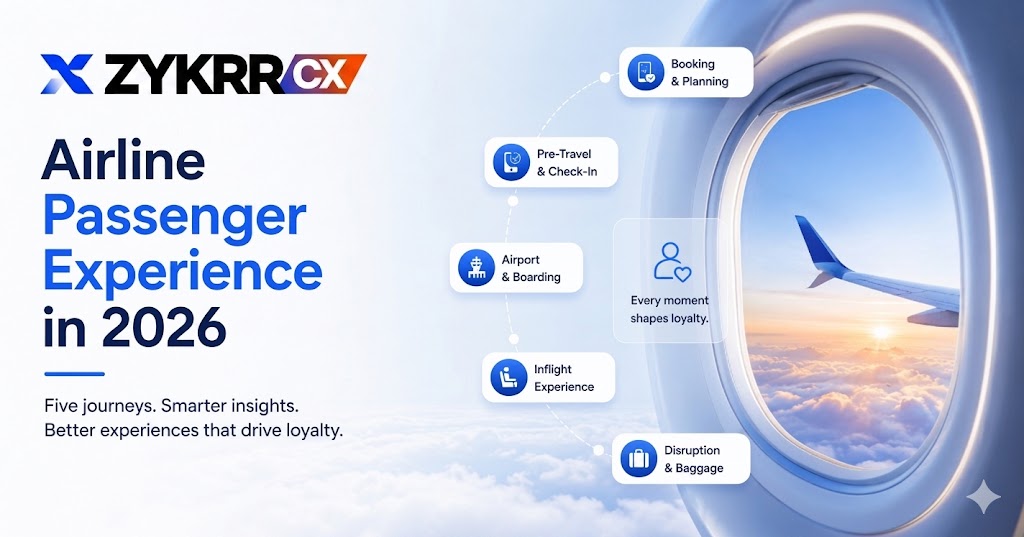
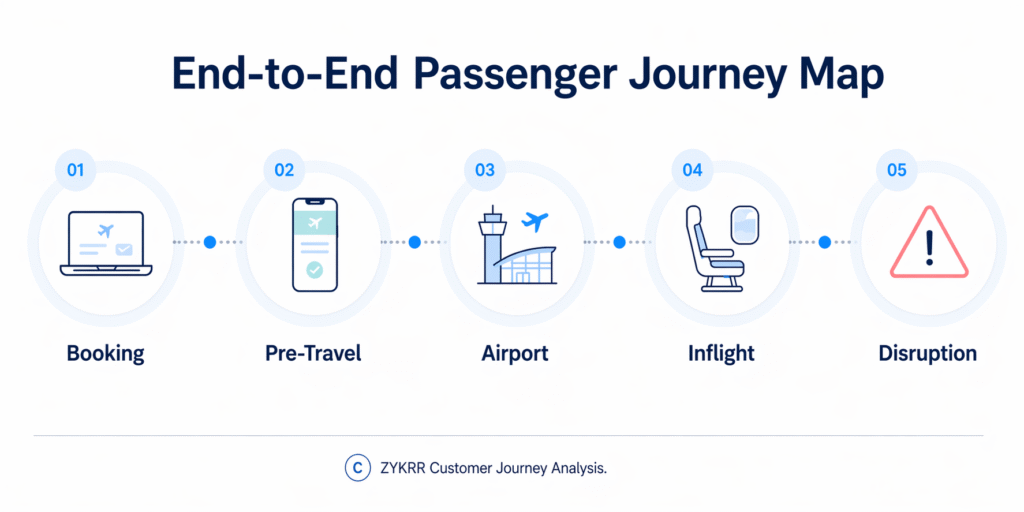
The five journeys that shape airline passenger experience
Passengers do not think in departments. They think in experiences. Five journeys determine whether someone flies with you again or quietly switches.
1. Booking and Planning
This is where expectations get set. The booking journey covers fare search across website, app, and partners. How clearly you present baggage rules, seat options, and ancillaries. How well mobile payment works.
When booking is confusing, passengers default to online travel agencies. That costs you the direct relationship and higher-margin ancillary sales. 34% of travelers say a smooth digital experience is their top priority when booking a flight. If your website or app fails that test, you lose them before the journey even starts.
Airlines that get this right share a few traits: clean fare comparison, transparent total pricing, and a checkout flow that does not force passengers to re-enter information.
2. Pre-Travel and Check-In
Between booking and the airport, passengers want reassurance and control. Pre-travel emails, app notifications, digital check-in, seat changes, baggage purchase, document verification.
Mobile check-in usage grew from 62% in 2021 to 78% in 2023, with 41% completing the process in under two minutes (Airlines Reporting Corporation). Passengers want pre-travel tasks on their phones, and they expect it to be fast.
The airlines that do this well send the right message at the right time. Not 14 emails before departure. Not zero communication for a week and then three notifications in an hour.
3. Airport and Boarding
Airports are where airline passenger experience gets complicated. Much of it is outside your control, but passengers do not see that. They bought a ticket from you. If the security line is chaotic and the signage is confusing, that gets filed under your brand.
Long wait times at check-in can cut passenger satisfaction by as much as 25%. Nearly half of passengers consider terminal cleanliness a top factor in their experience. These things happen before anyone boards the aircraft. If the airport feels chaotic, NPS drops even if the flight is fine.
4. Inflight Experience
Inflight is where crew, cabin product, and catering come together. Seat comfort, cleanliness, crew attitude, food quality, Wi-Fi, entertainment.
J.D. Power’s 2023 North American Airline Satisfaction Study put the overall score at 791 out of 1,000, down seven points from 2022. In the premium economy segment, Delta Air Lines led with 848, followed by JetBlue at 840 and Alaska Airlines at 823. Southwest topped the economy segment at 827.
Small details matter more than you would expect here. 62% of passengers cite friendly staff as the top factor in satisfaction, according to an Airlines for America survey. A single warm interaction from a crew member can offset a 45-minute delay more effectively than a generic voucher.
Airlines offering high speed Wi-Fi report measurably higher airline passenger experience satisfaction levels. In-flight entertainment availability also has a significant positive effect on satisfaction scores. These are not marginal factors. They influence which airline passengers choose next time.
5. Disruption and Baggage
This journey either loses you a customer permanently or earns the kind of loyalty that no marketing budget can buy.
68% of customers switch to a competitor after a single poor service experience. 84% of frustrated passengers tell at least ten people about it. When passengers have to fight to get rebooked, call multiple numbers, and wait with no information, they do not forget.
Airlines that handle disruption well share common practices: proactive communication before passengers ask, fair rebooking options in the app, and frontline staff empowered to solve problems without three layers of approval. Only 25% of passengers feel that customer service agents are actually empowered to solve their problems. That gap is where you lose people.
87% of airline customers expect a response to a social media complaint within 60 minutes. If your disruption process is slow, passengers will not wait for your contact center. They will take it to Twitter.
Metrics that work for airline passenger experience
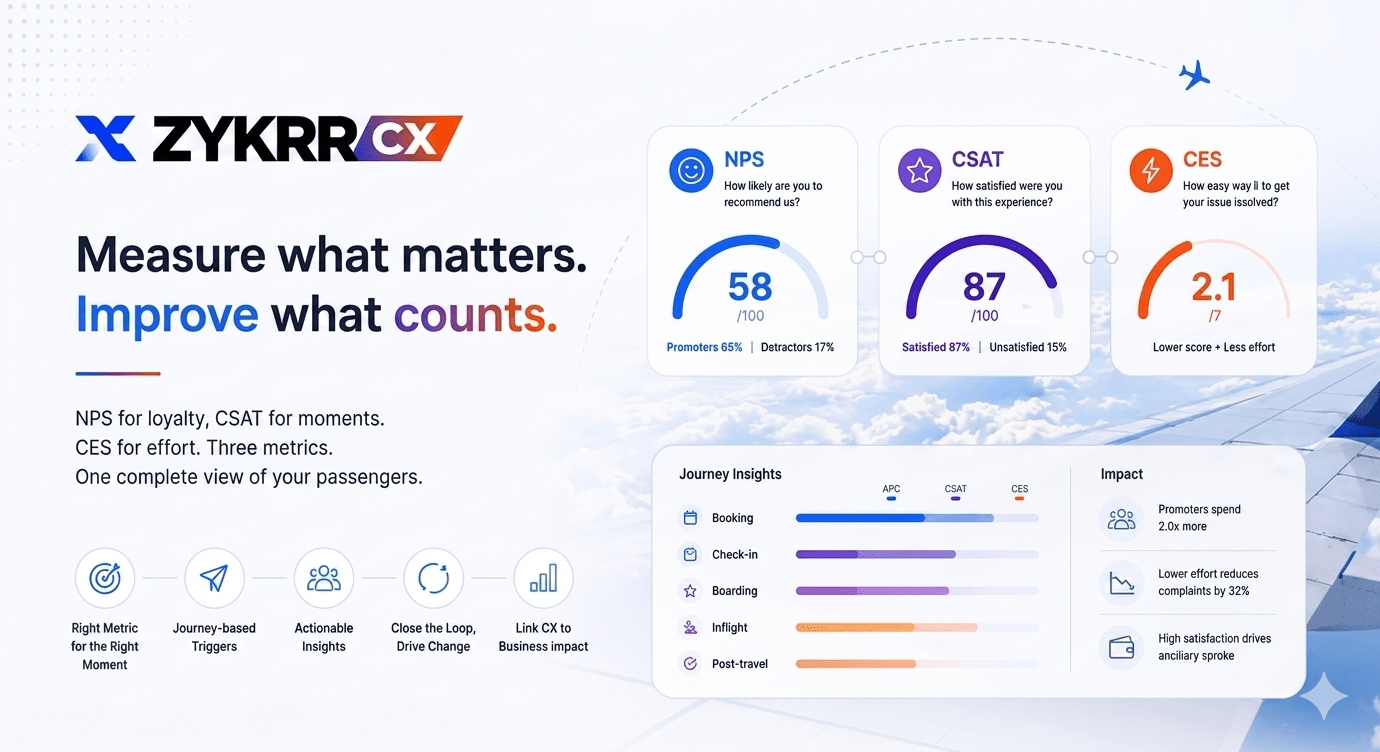
The mistake most airlines make is picking one metric and expecting it to tell the whole story. You need NPS, CSAT, and CES, each applied to the right journey.
NPS for relationship health
Net Promoter Score gives a directional view of long term loyalty. Trackairline NPS by route, cabin class, and segment. According to Bain and Company, NPS leaders in most industries outgrow their competitors by more than two times, and NPS explains 20% to 60% of the variation in organic growth rates among competitors.
NPS is a trailing indicator, not a diagnostic tool. By the time your NPS drops, the damage has already happened. The value of NPS is in tracking trends over time and comparing segments. If your London route NPS is 45 but your Miami route is 22, that tells you where to focus. Combine it with journey-specific metrics to find out why.
CSAT for specific interactions
Deploy airline CSAT after booking, check-in, contact center calls, baggage recovery, and lounge visits. Episode level CSAT pinpoints which part of the journey is degrading loyalty.
Do not over-survey. Target the moments that matter and rotate your schedule to avoid fatigue.
CES when passengers hit friction
Customer Effort Score is powerful in disruption and problem resolution. Use it after rebooking, refund requests, baggage claims, and multi-contact complaints.
High CES is one of the strongest churn predictors in aviation. CES also catches process failures that NPS and CSAT miss. A passenger might give a decent CSAT because the agent was friendly, even though the process was needlessly complicated. CES catches that gap.
Breaking the patterns that hold airlines back
Three patterns prevent passenger experience programs from delivering value.
The most common is running sporadic NPS surveys that never reach the people who can act. A quarterly deck for the VP is not useful if station managers and crew leads never see the data.
Then there is treating feedback as compliance. Airlines collect surveys, file results, and move on. Scores look fine on paper while actual passenger experience quietly deteriorates. The survey becomes something the CX team runs, not something the operations team uses. That disconnect is where most airline CX programs stall.
The last one is collecting thousands of verbatim comments with no way to analyze them at speed. Airlines receive thousands of open-ended comments every week across post-flight surveys, app reviews, social media, and contact center logs. Without text analytics and theme detection, those comments sit unread. The passengers who took time to write them get no response, and the patterns in their feedback never reach anyone who could act.
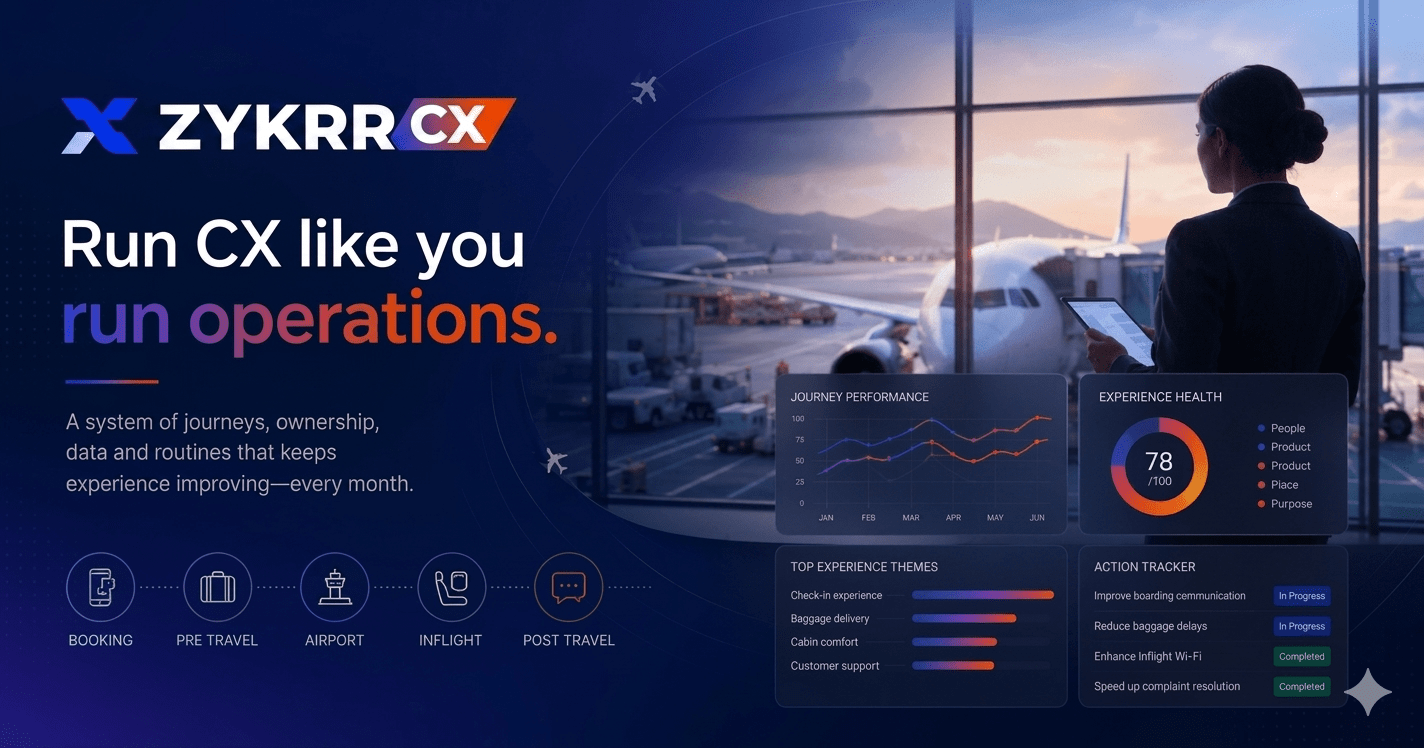
Breaking these patterns means defining journeys clearly, assigning metrics to each one, giving teams ownership of actions, and flowing data into a single passenger experience management platform instead of scattering it across six or seven disconnected tools.
What changes when you centralize passenger experience management
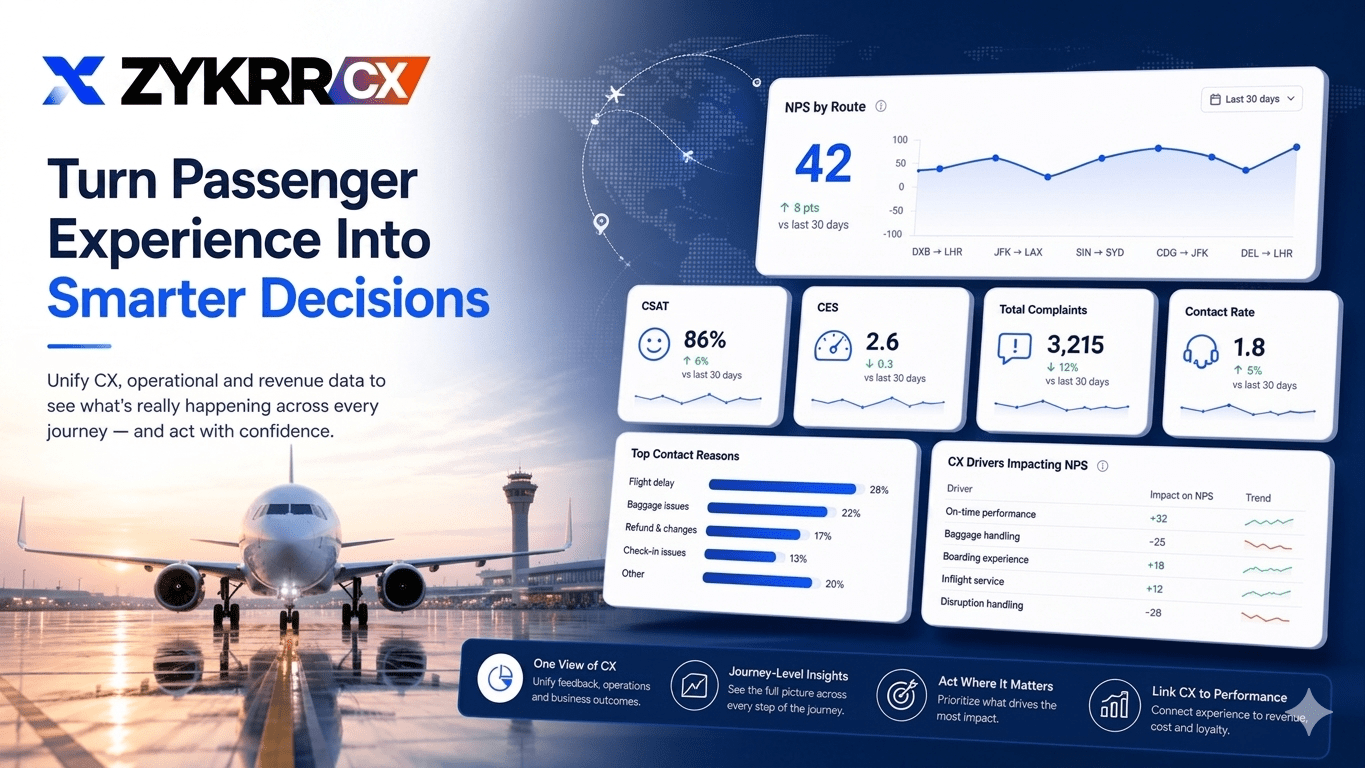
When you bring passenger signals into one platform, you see booking, airport, inflight, and baggage feedback on a single timeline per passenger. You prioritize high value customers and sensitive cases. You connect passenger experience issues to operational data like delay codes, aircraft type, and crew scheduling. You show leadership which fixes protect the most revenue.
Without this connection, CX stays reactive. A low NPS on a route might be caused by a specific catering provider, a recurring aircraft swap, or a ground handling partner at one airport. You cannot find that by looking at survey scores alone. You find it by layering feedback data on top of operational data and letting the patterns emerge.
This is where ZYKRR fits. The platform brings feedback, operational data, and case management into one stack built for airline operations. It goes beyond reporting. It gives teams the workflows, alerts, and analytics to actually run the business around passenger experience. Learn more about how our airline passenger experience software works.
80% of airlines plan to invest in AI for customer service by 2026. The question is whether that investment connects to your passenger experience data in a way that improves outcomes.
Example airline passenger experience use cases with ZYKRR
Identify the top ten disruption scenarios that generate the most complaints and redesign communication templates for each. Tailor the message to the situation rather than blasting the same generic delay email.
Track how boarding procedure changes affect both on-time performance and passenger sentiment. If a new policy improves OTP by two minutes but tanks satisfaction for families, you need to know before a system wide rollout.
Give station managers daily lists of unresolved low scores for premium cabins. Speed matters more than perfection in recovery.
Show route managers which destinations combine low NPS, high delay minutes, and high revenue risk. This cross referencing is nearly impossible when feedback and operational data live in separate systems.
Monitor social media sentiment alongside survey data to catch emerging issues before they become crises. A spike in negative mentions about a specific route can signal a problem days before survey data picks it up.
LLM helper prompts for airline passenger experience teams
Your CX team can use these prompts with ZYVA or any large language model to analyze passenger feedback faster. Feed them actual verbatim data from your platform for best results.
Disruption analysis
“You are a CX lead at an airline. Read these comments from delayed passengers on our top five routes. Group them into themes and suggest three changes that will reduce frustration.”
Contact center improvement
“You are a contact centre manager. Analyse this week’s low CSAT calls and highlight the top policy reasons behind dissatisfaction.”
Mobile app UX
“You are a product manager for our mobile app. Review these app store reviews about check-in and list the top five UX issues and potential fixes.”
Route performance
“You are a route analyst. Compare NPS scores, delay minutes, and complaint volume for these ten routes. Rank them by revenue risk and recommend which three to investigate first.”
Baggage recovery
“You are a ground operations manager. Read these baggage complaint comments from the past 30 days. Identify whether the issue is tracking visibility, communication speed, or resolution process, and suggest one fix for each.”
Frequently
Asked Questions
-


How do airlines measure passenger experience?
Airlines typically use three metrics in combination. NPS (Net Promoter Score) measures overall relationship health and loyalty. CSAT (Customer Satisfaction Score) measures how passengers felt about a specific interaction like check-in or a support call. CES (Customer Effort Score) measures how hard passengers had to work to resolve an issue, especially during disruption.
-
Why does disruption handling matter so much for passenger experience?
68% of customers will switch airlines after a single poor service experience. 84% of frustrated passengers tell at least ten other people. Disruption is inevitable in aviation. The experience around it, how fast you communicate, how fair your rebooking options are, and how empowered your staff is, separates airlines that retain customers from those that lose them.
-
How can AI improve airline passenger experience?
AI helps airline CX teams in a few concrete ways. Text analytics can process thousands of verbatim comments per week and surface themes that manual review would miss. Automated alerts can flag high risk cases for priority follow-up, like a frequent flyer who had both a delay and a baggage issue on the same trip. And LLM-based prompts let teams analyze feedback data and pull out specific recommendations faster than anyone could do by hand.
-
What is the difference between airline customer experience and passenger experience?
The terms are often used interchangeably. In practice, customer experience covers the full commercial relationship including loyalty programs, pricing, and marketing. Passenger experience focuses on the operational journey from booking through arrival. Both matter, but passenger experience is where operational teams have the most direct ability to improve outcomes.
-
How often should airlines survey passengers?
Post-flight NPS can be sent after every trip, but keep it short. Episode-specific CSAT works best when triggered by a specific event like a support call or baggage claim. Avoid surveying the same passenger across multiple touchpoints on the same trip. Survey fatigue kills response rates, and low response rates produce unreliable data.
What to Do This Quarter
Stop measuring airline passenger experience at the brand level. Start measuring it at the journey level.
Pick the two journeys where performance is weakest. Assign the right metric to each. Connect feedback data to operational data so you can find root causes, not just symptoms. Close the loop fast enough that passengers know you are listening.
The airlines that win in 2026 will not be the ones with the fanciest surveys. They will be the ones with a feedback loop tight enough to catch problems before passengers complain and fast enough to fix them before passengers leave.