Most airlines start the same way. A survey tool here. A spreadsheet there. Someone in the CX team builds a local solution that works for their station, and it stays in use for years because nobody has the budget or appetite to replace it.
Over time, these fragments become a barrier. Corporate teams cannot see what is happening at each station. Station managers only see their own feedback, not patterns across the network. Contact centre, airport, and digital product teams each work off separate dashboards that show different numbers for the same problems.
The result is a CX program that generates data but does not generate change. Scores get reported. Decks get circulated. But the station manager in Dallas has no idea that the same boarding complaint is showing up in Chicago, Miami, and JFK. Nobody connects the dots because the dots live in different systems.
Disruptions now cost airlines an estimated $60 billion annually, roughly 8% of global revenue, according to Wipro’s industry analysis. A meaningful share of that cost comes from poor experience recovery, not from the disruption itself. When passengers have a bad experience and nobody follows up, the airline pays in churn, negative reviews, and lost ancillary revenue.
An airline CX platform replaces this patchwork with a single system that listens across every channel, analyzes at the journey level, and gets the right action to the right person at the right time.
Table of Contents
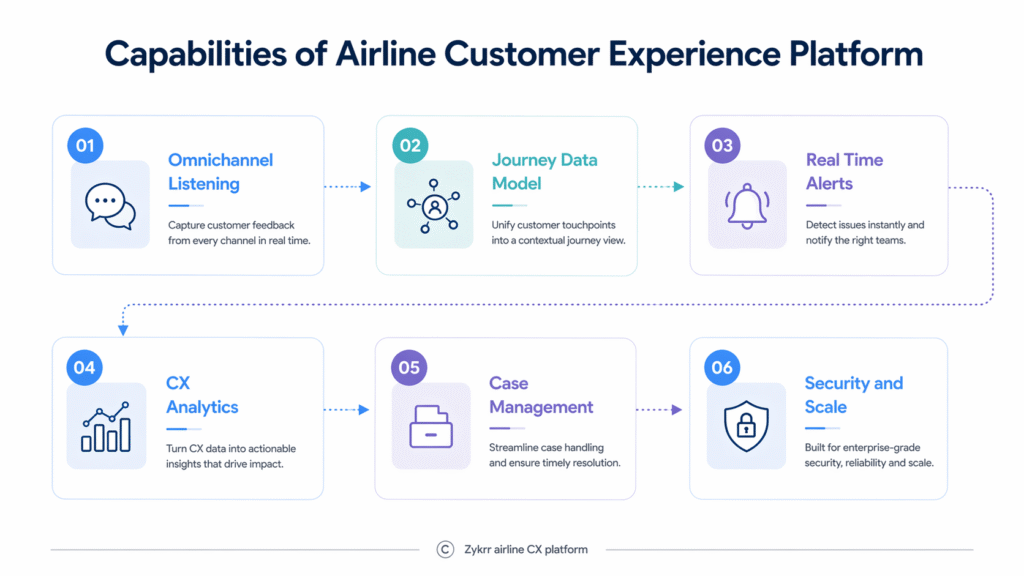
Six capabilities every airline CX platform needs
A credible platform for airlines has to cover six areas. Miss any one of them and you end up with gaps that force teams back into spreadsheets.
1. Omnichannel listening
The platform must capture feedback from every channel passengers use. That means web and app journeys like booking, check-in, and managing reservations. Kiosks and QR codes at airports. Contact centre calls, email, and chat. Social media, review sites like Skytrax and TripAdvisor, and formal complaint forms.
The key is not just collecting from multiple sources. It is tying every signal back to a customer identity, a specific flight, and a booking channel. Without that link, you have volume without context.
IATA data shows close to 5 billion passenger journeys were completed in 2024. Industry estimates suggest airlines handle over two contact interactions per booking on average across chat, voice, and social. A single weather event that grounds 1,200 flights can spike contact volume by 800% in three hours. The listening layer has to handle that kind of surge without dropping signals.
2. Journey centric data model
The platform should organize data around journeys, not isolated tickets or survey responses.
That means mapping feedback to five core stages: booking, pre-travel, airport, inflight, and post-travel. It also means handling disruption-specific journeys like cancellations, misconnects, and involuntary reroutes. And baggage journeys from loss report through to recovery and compensation.
When you organize data this way, you can see how one failure cascades across an entire trip. A passenger who had a bad check-in experience, then a delayed flight, then lost luggage is not three separate cases. It is one journey that went wrong in three places, and the cumulative effect on loyalty is far worse than any single incident.
If you want to understand how these journeys work in detail, our guide to airline passenger experience breaks them down with metrics for each stage.
3. Real-time alerts and workflows
Collecting feedback is the easy part. The hard part is converting risk into action before it becomes a complaint, a social media post, or a lost customer.
The platform needs alert rules that trigger when high value passengers give low scores or mention specific issues. It needs workflows that route those alerts to the right person: station teams for airport issues, crew managers for inflight problems, contact centre leads for service recovery failures.
And it needs playbooks. When a premium passenger gives a 2 out of 10 after a disruption on a transatlantic route, the response should not depend on which agent happens to see it. There should be a predefined sequence: acknowledge within two hours, offer specific recovery options, and follow up within 48 hours. Playbooks remove improvisation from high-stakes recovery.
Philippine Airlines reduced contact centre wait times from two hours to under one minute after building structured workflows and AI-assisted routing into their CX stack. Their customer satisfaction jumped from the low 60s to around 95% across more than 500,000 surveys annually.
4. CX analytics and reporting
Dashboards are the most visible part of any CX platform, but they are also where most platforms fail airlines. The problem is not a lack of charts. It is a lack of operational relevance.
An airline CX platform has to support dashboards by route, station, cabin class, and channel. It needs to show trends in NPS, CSAT, CES, and complaint volumes over time. And it needs to correlate experience scores with operational metrics like on-time performance, delay minutes, and baggage mishandling rates.
Without that correlation, CX analytics stays in its own silo. The CX team knows scores are dropping on a route, but they cannot tell operations whether the problem is a specific ground handler, a recurring aircraft swap, or a catering provider change. When experience data and operational data live in the same platform, the root causes become visible.
5. Case management and closed loop follow-up
Feedback should not die in a shared inbox. Each significant issue needs to become a case with an owner, a due date, and a status.
Escalation rules should route sensitive cases to the right leaders. A frequent flyer who has had two negative experiences in the same month should not be handled by a first-line agent working from a generic script. That case needs to go to someone with authority and context.
Outcomes should be tracked so you can see which actions actually change scores. If your team resolves 200 cases a month but satisfaction does not improve, something about the resolution process is not working. Closed loop tracking exposes that.
Only 25% of airline passengers feel that customer service agents are empowered to solve their problems. Case management with clear escalation rules and authority levels is how you close that gap.
6. Security, privacy, and scale
Airlines handle some of the most sensitive personal data in any industry. Passenger Name Records, passport information, loyalty tier data, payment details, health documentation for special assistance.
The platform must meet regulatory requirements across every market you operate in. GDPR for European routes. PCI-DSS for payment data. Country-specific data residency rules for certain markets.
And it must handle volume spikes. Holiday seasons, major disruptions, and new route launches all create surges in feedback volume. A platform that struggles during a Thanksgiving storm is a platform that fails when you need it most.
Data sources your airline CX platform must connect
An airline CX platform does not work in isolation. It needs to pull from and push to the systems that run your operation.
Reservation and ticketing systems (like Amadeus Altea or Sabre) for flight details, fare class, and booking channel. Loyalty systems for tier status, lifetime value, and redemption history. Departure control and airport systems for check-in, boarding, and baggage tracking. Contact centre platforms for call and chat records. Digital analytics tools for web and app behavior.
The goal is not to build a new data warehouse. It is to join just enough context so that when a CX analyst looks at a low NPS score, they can immediately see the flight, the delay code, the passenger’s loyalty tier, and whether the contact centre was involved. That context is what turns a score into something you can act on.
Amadeus Altea alone hosts inventory for more than a hundred airlines worldwide. If your CX platform cannot integrate with the PSS your airline runs on, it is not a real airline CX platform.
How ZYKRR works as an airline CX platform
ZYKRR is built as a modular CX platform that fits into existing airline technology stacks. It covers the six capabilities described above through four functional layers.
Signals capture structured surveys and unstructured feedback from all channels, tied to flight and passenger identity.
Intelligence builds journey-aware analytics that combine NPS, CSAT, CES, and operational data into views that make sense for airline roles: route managers, station leads, crew supervisors, contact centre heads.
Actions power case management, workflows, and playbooks tailored to airline operations. When a premium passenger flags a disruption issue, the platform routes it, assigns it, and tracks it through resolution.
Monetization links experience improvements to business outcomes like churn reduction, repeat purchase rates, and ancillary revenue. This is what turns CX from a cost centre into a revenue driver.
Airlines can start with one or two journeys and expand as they see results. You do not need to boil the ocean on day one. Learn more about how our airline customer experience software works for a broader view of the platform.
Implementation roadmap: From zero to full-scale airline CX
Ripping out existing tools and going live with a full platform on day one is a recipe for failure. A phased rollout reduces risk and builds internal confidence.
Phase 1: Define outcomes and initial journeys
Pick two or three journeys where you know performance is weakest. Choose clear targets: reduce complaints for delayed flights on three core routes by 20% in six months. Reduce average case resolution time from five days to two. Having specific targets keeps the implementation focused and gives you something to measure against.
Phase 2: Integrate minimal data
Connect reservation systems, primary feedback channels (post-flight survey, contact centre), and basic operational metrics (delay codes, OTP). Do not try to connect every system in the first phase. Get the core data flowing and validate that the platform can match feedback to flights and passengers accurately.
Phase 3: Launch listening and case management
Deploy surveys on the chosen journeys. Stand up case management workflows so that low scores and urgent issues get routed to the right people. This is where staff start seeing value. A station manager who gets a daily list of unresolved complaints for their airport will use it.
Phase 4: Roll out dashboards and routines
Give station managers, route managers, and leadership simple dashboards. Establish regular cadence calls: weekly for station teams, monthly for route performance, quarterly for leadership. The dashboards are only useful if someone looks at them on a rhythm.
Phase 5: Add AI and advanced analytics
Use AI to summarize open-ended comments, detect emerging themes, and draft response templates. This is where LLM capabilities like ZYVA add value. They do not replace human judgment, but they make it faster to process thousands of verbatim comments per week.
Phase 6: Expand journeys and connect to monetization
Scale across more routes and journey stages. Start linking experience improvements to revenue metrics: did fixing the disruption communication on the London route reduce churn among business travelers? Did improving check-in scores at JFK increase ancillary uptake? This phase turns CX from a reporting function into a business case.
LLM helper prompts for Airline CX platform teams
Your team can use these prompts with ZYVA or any LLM to get more from your platform data. Feed them real data for best results.
Platform integration planning
“You are a solutions architect for an airline CX platform. Review this list of existing tools and data sources and suggest a phased integration plan that delivers quick wins in 90 days.”
Case management audit
“You are a CX operations manager. Read these platform usage logs and highlight where agents are dropping cases without completing follow-ups. Suggest process changes to improve close rates.”
Comment theme detection
“You are a CX analyst at an airline. Read these 500 verbatim comments from post-flight surveys on our top ten domestic routes. Group them by theme and rank themes by frequency and severity.”
Dashboard effectiveness review
“You are a CX reporting lead. Review these dashboard screenshots and suggest which metrics should be removed because nobody acts on them, and which missing metrics would help station managers make better decisions.”
Vendor evaluation“You are a CX technology advisor for an airline. Compare these three platform proposals against the six capabilities an airline CX platform must have. Score each vendor and flag gaps.”
Frequently
Asked Questions
How is an airline CX platform different from a generic CX tool?
Generic CX tools are built for retail, SaaS, or hospitality workflows. They do not understand codeshares, PNRs, disruption codes, or the fact that an airline’s passenger journey involves dozens of third parties. An airline CX platform has a journey model built for aviation, integrates with reservation and departure control systems, and supports airline-specific workflows like disruption recovery and baggage case management.
What data does an airline CX platform need to integrate with?
At minimum: reservation and ticketing (Amadeus, Sabre), loyalty, departure control and baggage systems, contact centre platforms, and digital analytics. The platform does not replace these systems. It pulls context from them so feedback can be matched to specific flights, passengers, and operational conditions.
What ROI should airlines expect from a CX platform?
ROI depends on airline size and current maturity. Common outcomes include reduced complaint resolution time, lower contact centre cost per interaction, improved NPS on targeted routes, and measurable reductions in churn among high value passengers. Philippine Airlines, after restructuring their CX operations, turned their contact centre from a cost centre into a profit centre while raising satisfaction from the low 60s to around 95%.
How does ZYKRR compare to generic CX platforms like Qualtrics or Medallia?
ZYKRR is built specifically for industries like aviation where journeys involve multiple third parties, operational constraints, and complex disruption scenarios. It offers airline-specific journey models, integrations with reservation and departure control systems, and workflows designed for station managers, crew leads, and contact centre teams. Generic platforms can collect surveys, but they typically lack the aviation-specific data model and operational integrations that make feedback useful at the operational level.
Can smaller airlines benefit from a CX platform?
Yes. Smaller carriers often have an advantage because they have fewer legacy systems and shorter decision cycles. A regional airline operating 30 routes can go from zero to a working CX platform faster than a global carrier with 300 routes and a dozen PSS integrations.