

Where airline CX software fits in your tech stack
Airline technology is crowded. You already run reservation systems, departure control, loyalty, revenue management, digital analytics, and contact centre platforms. Adding another system is nobody’s idea of fun.
Airline CX software sits across these systems.
• It listens to passengers wherever they interact.
• It turns feedback into structured data and cases.
• It connects experience information with operations and revenue.
Think of it as the layer that ties everything together from the passenger’s perspective, not the airline’s internal org chart.
The global aviation software market hit $13.1 billion in 2025 and is projected to reach $18.1 billion by 2030, growing at 6.6% annually, according to Mordor Intelligence. Airlines are investing heavily in digital tools. The question is whether your CX software can keep pace with the rest of your stack, or whether it is the weak link holding everything back.
Choosing the right software is less about long feature lists and more about fit with airline realities. Can it handle disruption spikes when a storm grounds 200 flights and feedback volume jumps tenfold overnight? Does it understand codeshares and interline agreements, or does it treat every ticket as if a single airline controlled the whole journey? Can your station manager in Dallas actually use it at 6 AM without calling IT?
Most airlines that struggle with CX software do not have a technology problem. They have a fit problem. They bought a tool designed for retail or hospitality and tried to make it work for aviation. It did not.
Table of Contents
Must-have features for airline CX software
Not every feature on a vendor’s slide deck matters. These are the ones that do.
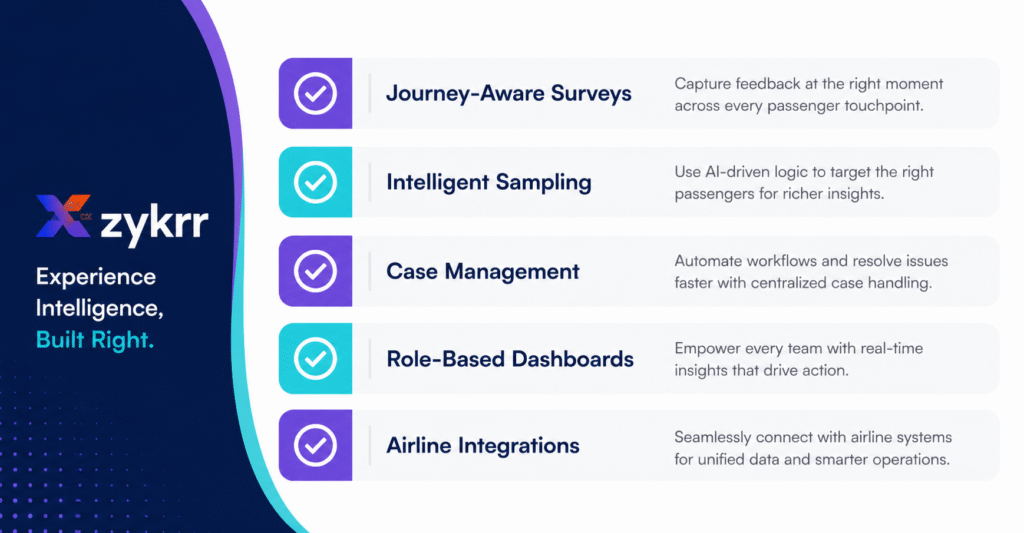
1. Journey-aware survey engine
Your software has to understand where a passenger is in the journey. A post-booking survey is different from a post-disruption survey, and both are different from an inflight feedback prompt.
• It needs to trigger different surveys for booking, airport, inflight, and baggage events.
• It should use digital behaviour and operations data to time invitations so they arrive when the experience is fresh, not three days later when the passenger has already moved on.
• And it needs to avoid over-surveying frequent flyers who are already drowning in feedback requests, while still capturing enough signals on low-volume routes to be useful.
For a detailed breakdown of which metrics to assign to each journey stage, see our guide to airline passenger experience.
2. Intelligent sampling and throttling
Passengers will not respond if you bombard them. This sounds obvious, but most airlines still get it wrong. They either survey everyone after every flight and watch response rates drop to single digits, or survey so infrequently that they miss problems entirely.
Good airline CX software lets you set business rules by route, cabin, tier, and channel. It protects sensitive journeys like disruption recovery from survey fatigue. And it makes sure you still capture enough feedback on thin routes where every response counts.
3. Case management and escalation
Feedback without follow-up creates cynicism, both among passengers and among your own staff. If a station manager sees low scores every week but nothing ever happens, they stop looking.
• Your CX tool needs to turn low scores, complaints, and critical comments into trackable cases with an owner, a due date, and a status.
• Cases should route to the right team: stations for airport issues, contact centre for service recovery, specialist teams for baggage or accessibility.
• And there should be clear escalation paths for premium customers and special service needs so that a top-tier frequent flyer who just had their third bad experience does not get handled by a first-line agent reading from a generic script.
Only 25% of airline passengers feel that customer service agents are empowered to solve their problems. Case management with clear authority levels is how you start closing that gap.
4. Role-based dashboards
Different teams need different views of the same data.
• Executives want a monthly picture of trends and risk: which routes are declining, which segments are at risk, where is the biggest revenue exposure from poor experience.
• Station managers want day-by-day performance: what happened yesterday, which cases are open, what needs attention today.
• Product and digital teams want detailed journey analytics: where passengers drop off, which app flows generate complaints, how a recent release affected check-in scores.
You should be able to tailor these views without custom development every time someone needs a different cut of the data.
5. Airline-ready integrations
This is where most generic CX tools fail. They can collect surveys, but they cannot connect feedback to the systems that run your airline.
• Your CX software needs proven integrations with reservation and ticketing systems like Amadeus or Sabre, so feedback maps to specific flights, fare classes, and booking channels.
• Loyalty and CRM platforms, so you know who you are talking to and what they are worth to you.
• Contact centre platforms, so you can see whether a low-scoring passenger already called three times.
• Web and app analytics, so you can correlate digital behaviour with satisfaction scores.
Amadeus Altea alone hosts inventory for more than a hundred airlines worldwide. If your CX software cannot connect to your PSS, you are building on sand.
Without these integrations, you spend more time on plumbing than on CX. And your analysts spend their days manually joining spreadsheets instead of finding patterns.
Ask every vendor one question during the evaluation: how many airlines are live on your platform today, and which PSS integrations do you have in production?
If the answer involves the words “custom development” or “API available upon request,” expect six months of integration work before you see any value. Proven, production-tested connectors are not a nice-to-have. They are the difference between a 90-day time to value and a 12-month IT project.
Advanced features that separate good software from average
The features above are table stakes. These are what move an airline from collecting feedback to actually changing the business.
1. LLM-driven text analysis
Airlines receive thousands of open-ended comments every week. No human team can read them all. Modern airline CX software should embed large language models that can summarise those comments into clear themes, detect emotion and intensity (not just binary positive/negative sentiment), and suggest response templates that agents can personalise.
This is not about replacing human judgment. It is about giving humans the ability to process a volume of feedback that would otherwise sit unread. ZYVA, built into the ZYKRR platform, does exactly this.
2. Proactive risk models
Good airline CX software does not wait for a complaint. It looks at journey history, delays, past scores, and contact centre activity to predict which passengers are at risk of churning or escalating.
When a frequent flyer has a delay, a baggage issue, and a low CSAT score all in the same month, the system should flag that case for proactive outreach before the passenger takes it to social media. 68% of customers switch to a competitor after a single poor service experience. Catching at-risk passengers early is worth more than any recovery voucher.
3. Playbooks in the workflow
Frontline teams need guidance, not just tickets. When a case lands on a station manager’s screen, they should see recommended steps embedded right there: what to say, what to offer, what to escalate.
Playbooks standardise what good looks like for high-stakes journeys. Disruption recovery has a playbook. Baggage delay has a playbook. Premium passenger service failure has a playbook. Without them, every recovery is improvised, and the quality depends entirely on which agent happens to pick it up.
Philippine Airlines restructured their CX operations with workflow-based playbooks and AI routing, and saw customer satisfaction jump from the low 60s to around 95% across more than 500,000 annual surveys, according to a 2026 CDOTrends interview with their VP of Customer Experience.
Common Implementation Mistakes to Avoid
Buying the right software is only half the battle. Most airline CX implementations fail not because the tool is wrong but because the rollout is.
• By far the most common mistake is treating CX software as an IT project driven only by procurement and technology teams. If the CX team, station operations, and contact centre leadership are not involved from day one, you end up with a technically correct system that nobody uses.
• Another frequent misstep is launching every feature at once without clear ownership. When you go live with surveys, dashboards, case management, alerts, and analytics all on the same day, nobody knows what to look at first. A phased rollout that starts with two journeys and expands as teams build confidence works far better than a big bang.
• Then there is focusing only on surveys and ignoring case management. Surveys generate scores. Case management generates action. If you have one without the other, you get data without change.
• And finally, measuring success by number of survey responses rather than by resolved issues and improved experience. A programme that collects 50,000 responses but closes zero cases is not a CX programme. It is a data collection exercise.
A lean rollout with clear business outcomes, specific route targets, and named owners for each journey beats a huge implementation every time. For a detailed phased roadmap, see our guide to airline CX platform implementation.
Building the business case for airline CX software
CX software is not cheap, and airline CFOs want to see numbers, not sentiment. To win budget, you need to frame the case in hard outcomes.
• Start with cost reduction. Fewer complaints per thousand passengers means lower contact centre cost. Lower repeat contact rates mean agents handle more unique cases per shift. Faster case resolution means fewer escalations that eat up senior staff time.
• Then add revenue protection. Higher NPS on delayed flights correlates with better rebooking rates and lower churn. Improved loyalty for frequent travellers means higher share of wallet and ancillary uptake. Forrester Research has estimated that each US airline leaves as much as $1.4 billion in annual revenue on the table by not improving passenger experience. That figure is widely cited by Deloitte and others and reflects how CX improvements drive repeat bookings and ancillary revenue.
Bain and Company’s research shows that NPS leaders outgrow their competitors by more than two times in most industries. If you can demonstrate that fixing the disruption journey on three routes will lift NPS by a measurable amount and reduce churn among your highest-value passengers, the budget conversation becomes much easier. CFOs respond to math, not to satisfaction scores in isolation.
ZYKRR’s monetization layer helps you build these links by connecting journey-level improvement to churn, upgrade behaviour, and share of wallet. It turns CX from a cost line into a revenue case. Learn more about how our airline customer experience software and platforms work.
LLM helper prompts for CX buyers and teams
Your team can use these prompts with ZYVA or any LLM to speed up evaluation and implementation.
Vendor Comparison
“You are a procurement lead at an airline. Compare these three CX software proposals and highlight gaps in airline-specific capabilities. Score each against journey awareness, case management, integrations, and analytics.”
Business Case Drafting
“You are a CX director at a mid-size airline. Take these performance metrics and draft a one-page business case for upgrading our airline CX software. Focus on complaint reduction, contact centre cost savings, and NPS improvement on our top five routes.”
Survey Design Review
“You are a CX research specialist. Review this set of post-flight survey questions and suggest changes that reduce survey length by 30% while keeping the most diagnostic questions for each journey stage.”
Implementation Risk Assessment
“You are a CX operations consultant. Review this implementation plan for new airline CX software and flag the top five risks. For each risk, suggest a mitigation step.”
Feature Prioritisation
“You are advising an airline CX team on which features to launch first. Given this list of available capabilities, rank them by impact and ease of deployment. Recommend a three-phase rollout plan.”
Frequently
Asked Questions
-


How is airline CX software different from a generic survey tool?
Generic survey tools collect responses. Airline CX software connects those responses to specific flights, passenger tiers, delay codes, and booking channels. It also includes case management, role-based dashboards, and integrations with airline-specific systems like PSS and DCS that generic tools do not support.
-
What should I look for when evaluating airline CX software?
Five things matter most: a journey-aware survey engine, intelligent sampling and throttling, case management with escalation rules, role-based dashboards that different teams can use without custom development, and proven integrations with your airline’s reservation, loyalty, and contact centre systems.
-
How much does airline CX software cost?
Costs vary depending on airline size, routes, feedback volume, and features. Most vendors offer subscription pricing. The more important question is ROI: what will the software save you in contact centre costs, churn reduction, and complaint resolution time? Build the business case around those numbers.
-
How long does implementation take?
A phased rollout typically starts delivering value within 90 days. Start with two or three journeys, connect core data sources, and launch listening plus case management. Full-scale deployment across all journeys and routes usually takes 9 to 12 months.
-
Can ZYKRR handle airline-specific requirements?
Yes. ZYKRR is built for industries like aviation where journeys span multiple third parties and operational constraints. It includes airline-specific journey models, integrations with reservation and departure control systems, case management for station and contact centre teams, and a monetization layer linking CX improvement to revenue outcomes.