

From CX projects to an experience management system
Most airlines run CX as a series of disconnected projects. Someone launches a new app. Cabin crew get retrained on service standards. A lounge gets refurbished. A post-flight survey goes live. Each project has its own budget, its own timeline, and its own measure of success. When it is done, the team moves on to the next thing.
The problem is that none of these projects connect to each other. The crew training does not reference the survey data. The app team does not know what complaints the station managers are dealing with. The lounge redesign was driven by a consultant’s recommendation, not by passenger feedback on which journey stages actually need fixing.
This is how airlines end up with decent CX scores and frustrated CX teams. The scores look acceptable because passengers give you credit for individual improvements. But the underlying experience is not getting better in a systematic way, because there is no system.
Airline experience management takes a different view. It treats CX as an operating system that runs alongside safety and operations, not as a project portfolio that competes for attention with everything else. That means:
• Journeys are clearly defined and documented.
• Owners are assigned for each journey.
• Data, meetings, and actions follow a consistent rhythm. And when something breaks, the system catches it before the passenger has to complain.
Delta Air Lines offers a useful reference point. Their Operations and Customer Center in Atlanta is a 24/7 nerve centre where operations and customer experience are managed together, not in separate rooms. When a disruption hits, the OCC coordinates across maintenance, weather, customer service, and rebooking teams simultaneously. Erik Snell, Delta’s Chief Customer Experience Officer, oversees more than 60,000 team members who deliver the passenger experience. That kind of structural integration is what airline experience management looks like at scale.
McKinsey estimates that data-driven CX transformation in airlines can deliver 5 to 10 percentage points of margin improvement. But the airlines that capture that value are the ones that build a system, not the ones that run a better survey. The difference between the two is experience management.
Table of Contents
Building an airline experience management framework
Before you can manage the experience, you have to define it. Most airlines skip this step. They start collecting feedback without agreeing on what they are measuring or why. The result is data without structure.
A working airline experience management framework has three components.
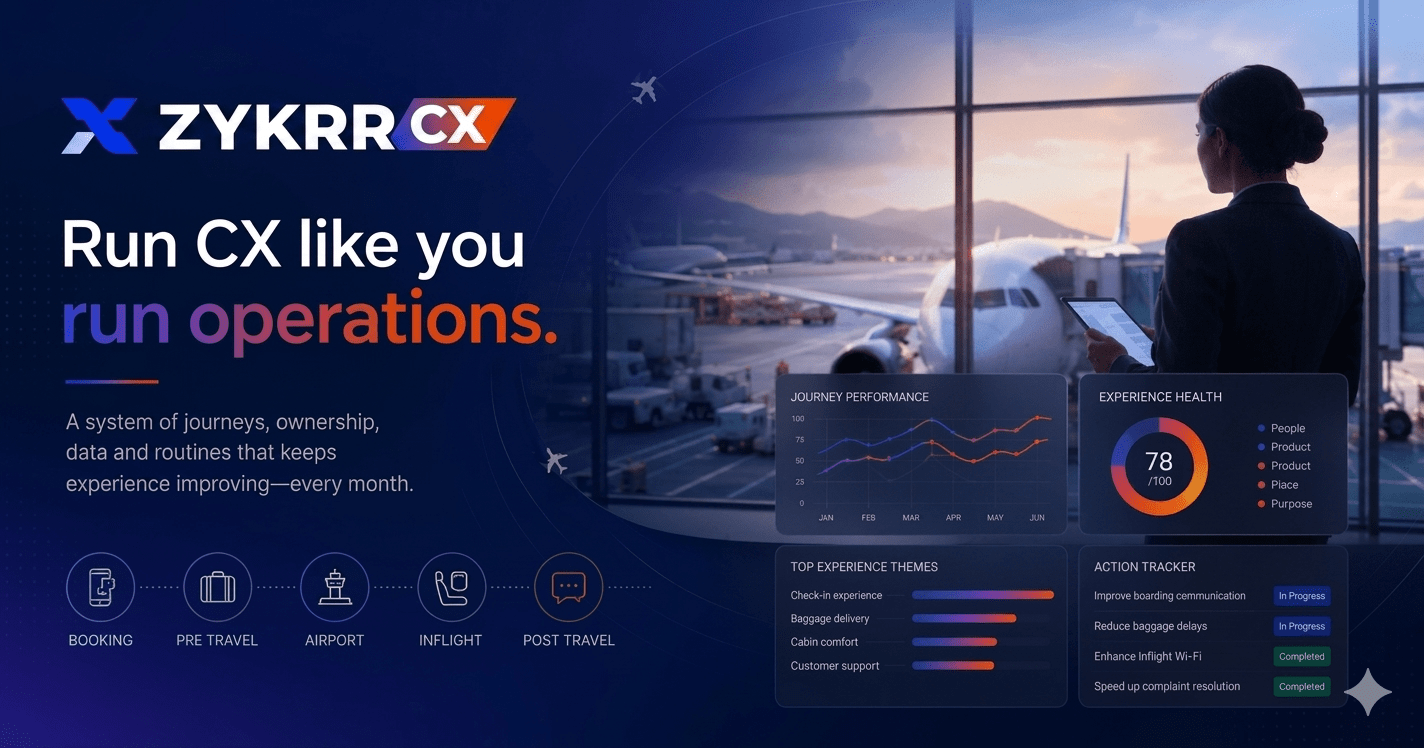
• Define the key journeys across booking, pre-travel, airport, inflight, and post-travel. For most airlines, five to seven journey stages cover 90% of what passengers care about. Add disruption and baggage as standalone journeys because their dynamics are different enough to warrant separate tracking. If you need a detailed breakdown of how these journeys work, see our guide to airline passenger experience.
• Map the personas that matter. Frequent business travellers, leisure families, first-time flyers, connecting passengers, and special assistance travellers all experience the same journey stages differently. A rebooking process that works fine for a solo business traveller can be a disaster for a family of four with checked bags and a car seat. Your experience framework should account for these differences without trying to build a separate programme for each persona.
• Set experience promises for each journey. These should be realistic but specific. “We will communicate proactively about delays” is better than “we will deliver a world-class experience.” The promises become the standard your teams measure themselves against and the benchmark for your CX analytics.

This framework becomes the backbone for your airline CX platform, your metrics programme, and your training content. Without it, every team interprets “good experience” differently, and your CX efforts pull in conflicting directions.
Governance: Who owns what across corporate, hubs, and stations
Good airline experience management respects the way airlines actually operate. You cannot run CX the way a retail chain or a software company does. Airlines have corporate headquarters, regional hubs, local stations, outsourced ground handlers, codeshare partners, and tens of thousands of frontline staff spread across time zones.
The governance model that works for most airlines has three layers.
• A central CX team that sets standards, runs the platform, drives analytics, and owns the overall framework. This team does not fix problems at individual stations. They make sure the system works so station teams can fix their own problems.
• Hubs and stations that own local execution and improvement plans. The station manager at JFK should know their NPS, their top complaints, their open cases, and their improvement priorities without waiting for corporate to tell them. If they need to change the boarding flow or retrain bag drop staff, they should have the authority and the data to do it.
• Cross-functional councils that bring together operations, digital, contact centre, and commercial leaders on a regular cadence. These councils are where CX gets connected to the rest of the business. If the digital team is about to release a new check-in flow, the station teams need to know because it will change what passengers ask at the counter. If operations is changing the boarding sequence, the CX team needs to model how it affects satisfaction scores. You can embed CX into existing operations reviews rather than creating parallel meetings.
Most airlines already have weekly station calls, monthly operations reviews, and quarterly business reviews. Adding a CX data point to each of those takes five minutes and costs nothing. Building a separate CX meeting cadence that competes with the operational calendar is the fastest way to make sure nobody shows up.
Operating routines that turn intentions into habits
Frameworks and governance structures may set the direction, but consistent operating routines are what turn airline experience management into something passengers actually feel.
• Daily or weekly huddles at stations to review yesterday’s CX incidents and today’s risks. This can be as simple as five minutes at the start of a shift where the station manager reads out three low scores from yesterday and asks if anyone knows what happened. At Delta, frontline employees are equipped with handheld devices that display customer data in real time, enabling them to spot and respond to issues as they happen.
• Monthly journey reviews where analytics and frontline stories are shared. This is where the CX team presents data on a specific journey stage (say, disruption recovery on the top five domestic routes) and the station teams share what they are seeing on the ground. The combination of quantitative data and qualitative context is where the best improvement ideas come from.
• Quarterly cross-functional reviews to decide bigger changes. These are decision meetings, not reporting meetings. The output should be a short list of funded actions with owners and deadlines. If the quarterly review produces a 40-page deck and no decisions, it is not working.
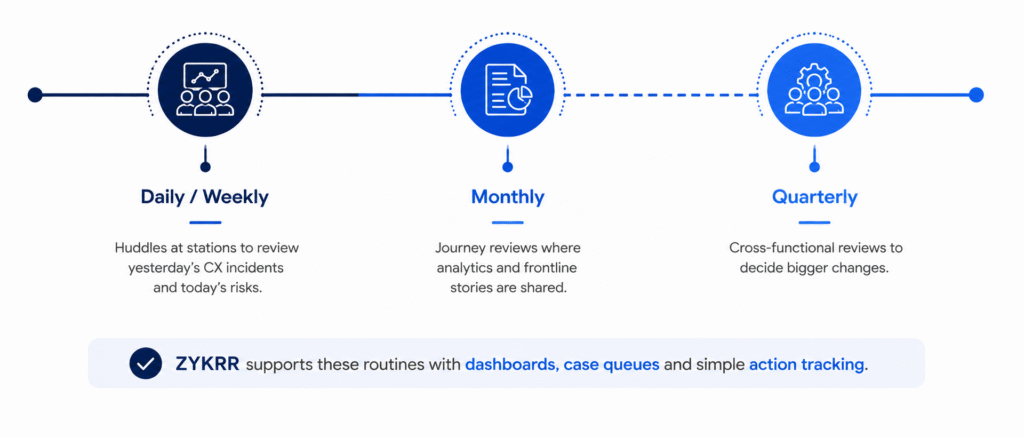
ZYKRR supports these routines with dashboards that match each cadence (daily station views, monthly journey reports, quarterly leadership summaries), case queues that show what needs attention now, and action tracking that connects decisions to outcomes. Learn more about how our airline CX platform enables these workflows.
Embedding CX into incentives and development
This is where most airline experience management programmes stall. The routines exist. The data flows. But nothing changes because nobody’s career depends on it.
To make experience management stick, link it to how people are recognised and promoted.
• Include CX metrics in performance reviews for leadership roles. If a station manager’s annual review includes NPS trend, case closure rate, and response time alongside operational metrics like OTP, CX becomes part of the job. If it is a separate add-on that leadership mentions once a year, it stays optional.
• Use real passenger stories in training, not generic scripts. Delta’s approach through Delta University provides ongoing education that connects service standards to actual passenger outcomes. When crew and station staff hear a real verbatim comment from a passenger whose trip was saved by a fast rebooking, it lands differently than a training module about “empathy.”
• Recognise crew and station teams that show strong closed-loop behaviour. Closed-loop means a low score came in, someone followed up with the passenger, and the outcome was tracked. The teams that do this well should be visible and celebrated. Gallup’s research on employee engagement consistently shows that teams who feel empowered to make decisions deliver better outcomes for customers. In aviation, where frontline staff interact with hundreds of passengers per shift, that empowerment translates directly into whether a disrupted passenger walks away angry or walks away impressed.
• Avoid narrow target chasing that encourages gaming scores. If you set a station NPS target of 45 and the station manager starts selectively surveying passengers who had good experiences, you have corrupted your data. Focus on trends, themes, and demonstrable actions rather than hitting a specific number. The goal is consistent improvement, not number manipulation.
Philippine Airlines offers another relevant example. After restructuring their CX operations with workflow-based playbooks and empowered agents, their customer satisfaction jumped from the low 60s to around 95% across more than 500,000 annual surveys, according to a 2026 CDOTrends interview with their VP of Customer Experience. That kind of result comes from systematic change, not from a better survey tool.
What airline experience management looks like when it works
When the system is running well, a few things become visible.
• Problems get caught before passengers escalate. A low NPS on a Tuesday morning at a specific gate gets flagged, investigated, and resolved within the week. The passenger who scored low gets a follow-up. The root cause (say, a new boarding agent who was not trained on the priority boarding sequence) gets addressed. The pattern gets watched to make sure it does not recur.
• Frontline staff start using feedback data without being told to. When a station manager checks their dashboard every morning because it actually helps them run a better shift, you have reached the point where CX is part of operations, not a parallel programme.
• Improvements compound. A better disruption communication template reduces complaint volume, which frees up contact centre capacity, which improves response time for remaining cases, which lifts CSAT. These cascading effects are what make airline experience management worth the investment. Individual projects create isolated wins. A system creates compounding ones.
This is also where your airline CX software and analytics investment starts paying back. When the framework, governance, and routines are in place, every feature in your CX platform gets used by someone who knows what to do with it. Without the management system around it, even the best software becomes an expensive dashboard that nobody looks at.
McKinsey documented a full-service carrier that achieved a 50 percentage point increase in digital experience NPS, increased ancillary revenue per passenger by over 50%, and reduced airport costs per passenger by nearly 20% through a targeted CX and technology transformation. Those numbers came from building a system, not from running better surveys.
LLM helper prompts for airline experience management leaders
Your CX leadership team can use these prompts with ZYVA or any LLM to accelerate experience management setup and review.
Cadence design
“You are a CX leader setting up airline experience management. Based on these roles and current meeting rhythm, propose a quarterly cadence that embeds CX into existing reviews without overloading teams.”
Station action planning
“You are a station manager. Read these last month’s complaints and suggest three actions we can commit to as a team in the next thirty days. Keep the actions specific and achievable.”
Framework audit
“You are a CX consultant reviewing an airline’s experience framework. Assess whether the journey definitions, persona mapping, and experience promises are specific enough to drive operational decisions. Flag gaps.”
Incentive design
“You are an HR and CX advisor. Review these performance review criteria for station managers and suggest how to integrate CX metrics without creating score-gaming incentives. Recommend balanced measures.”
Governance assessment
“You are an airline CX operations advisor. Review this governance model and identify where accountability gaps exist between corporate, hub, and station levels. Suggest fixes that respect airline operational realities.”
Frequently
Asked Questions
-


How is airline experience management different from running CX surveys?
Surveys collect data. Experience management turns that data into actions. It includes governance structures that define who owns each journey, operating routines that ensure problems get caught and fixed, case management that tracks follow-up, and incentive systems that make CX part of how people are evaluated and promoted.
-
What governance model works for airline experience management?
Three layers: a central CX team that sets standards and runs the platform, station and hub teams that own local execution, and cross-functional councils that connect CX to operations, digital, and commercial decisions. CX should embed into existing meeting rhythms rather than creating a separate calendar.
-
How long does it take to build an airline experience management system?
Most airlines can have a working framework, governance model, and initial routines in place within 90 days. The first journey reviews and case management workflows typically go live within that window. Full maturity across all journeys and stations usually takes 12 to 18 months.
-
What role does ZYKRR play in airline experience management?
ZYKRR provides the platform that powers the system: survey collection, journey-level analytics, case management, role-based dashboards for each cadence, action tracking, and a monetization layer that links CX improvements to revenue outcomes.
-
Can you show ROI from airline experience management?
Yes. By linking journey-level CX data to churn, repeat booking, ancillary revenue, and complaint handling costs, you can demonstrate financial impact. McKinsey documented one carrier that increased ancillary revenue per passenger by over 50% and reduced airport costs by nearly 20% through a systematic CX transformation.