


Airlines live and die on experience.
Seats, schedules and fares can be copied.
Trust and reliability cannot.
In 2026, disruptions, cost pressure and changing passenger behaviour are rewriting what good airline customer experience looks like. A modern airline needs more than a survey tool. It needs a connected airline CX platform that listens across channels, turns data into action and proves impact on revenue and loyalty.
This page explains how to design and choose airline customer experience software, where airline CX analytics fits in, and how tools like airline NPS, CSAT, CES and sentiment analysis can work together instead of living in silos.
Why airline customer experience is under pressure in 2026
Airline CX has always been complex.
Multiple partners, airports, regulators and digital channels all shape the journey.
Three shifts make experience management harder and more important now.
1. Passenger expectations have reset
Passengers expect consumer tech standards from every airline.
• They expect proactive communication before, during and after disruption.
• They expect digital self service for routine tasks and fast access to humans for edge cases.
• They expect consistent treatment across direct, agency and OTA bookings.
• They compare your airline with ride hailing, food delivery and streaming apps, not only other carriers.
When those expectations are not met, complaints show up on social media and review sites before your team can respond.
2. Legacy CX stacks were built for a different world
Most airlines still run fragmented tools.
• A marketing survey tool runs NPS once or twice a year.
• The contact centre has its own voice of customer system.
• Airport teams run local feedback processes.
• Operations rely on OTP dashboards that are disconnected from passenger sentiment.
This leads to blind spots. Negative social media sentiment, agent notes and operational data are not tied to customer identity or revenue value. The airline cannot see which experiences actually drive loyalty and which only create noise.
3. Regulators and partners care about CX too
Regulators are defining compensation rules, accessibility requirements and data rights. Airports and codeshare partners push for standard service levels. Poor airline customer experience now has cost, compliance and partnership implications, not just reputation risk.
What is airline customer experience software
Airline customer experience software is a platform that brings all passenger signals, journeys and actions into one system.
A modern airline CX platform should offer:
• Omnichannel listening : It should capture feedback from surveys, contact centre calls, email, chat, social media, mobile apps and kiosks.
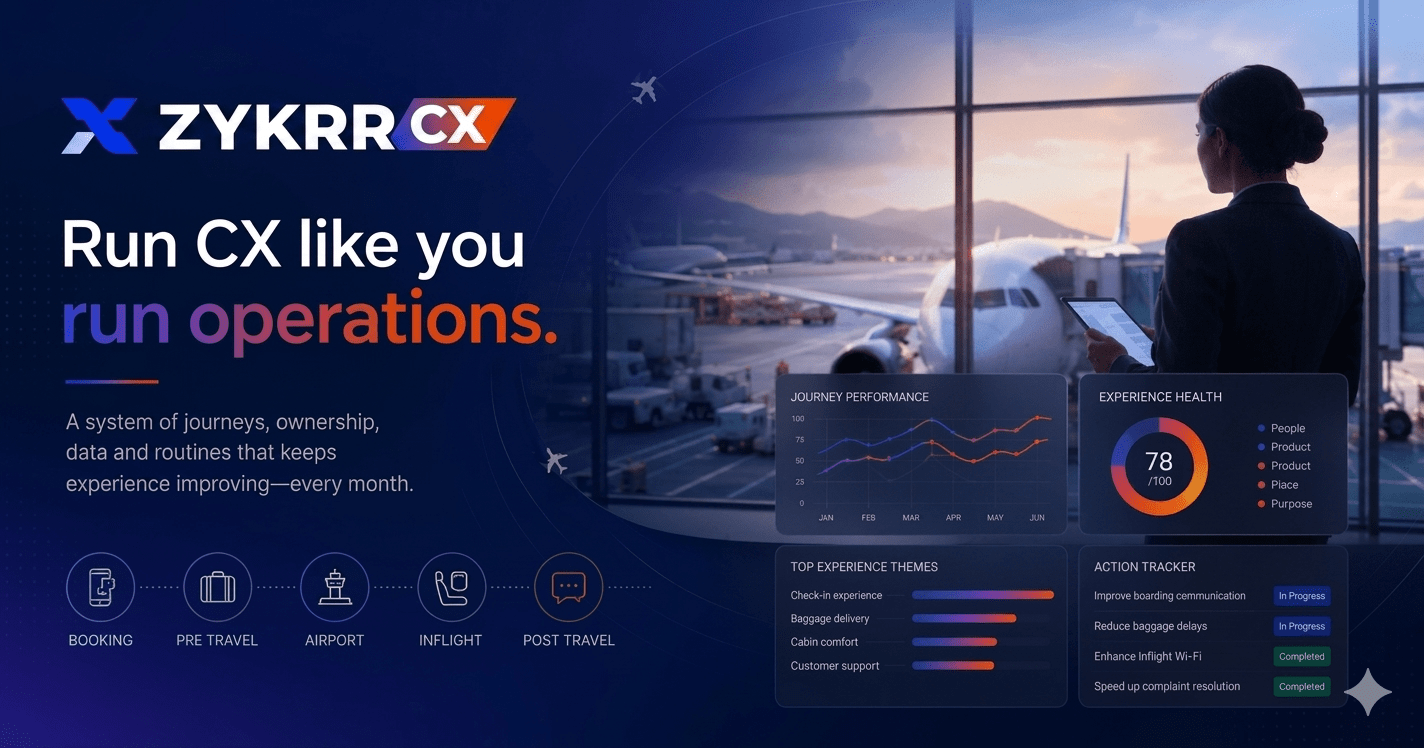
• Journey based modelling: It should map interactions across booking, pre travel, airport, inflight and post travel instead of treating every survey or contact in isolation.
• Real time alerting: It should notify teams when high value passengers, special assistance cases or journeys at risk need attention.
• Closed loop case management: It should convert feedback into cases with owners, due dates and resolution tracking, rather than leaving issues as raw comments.
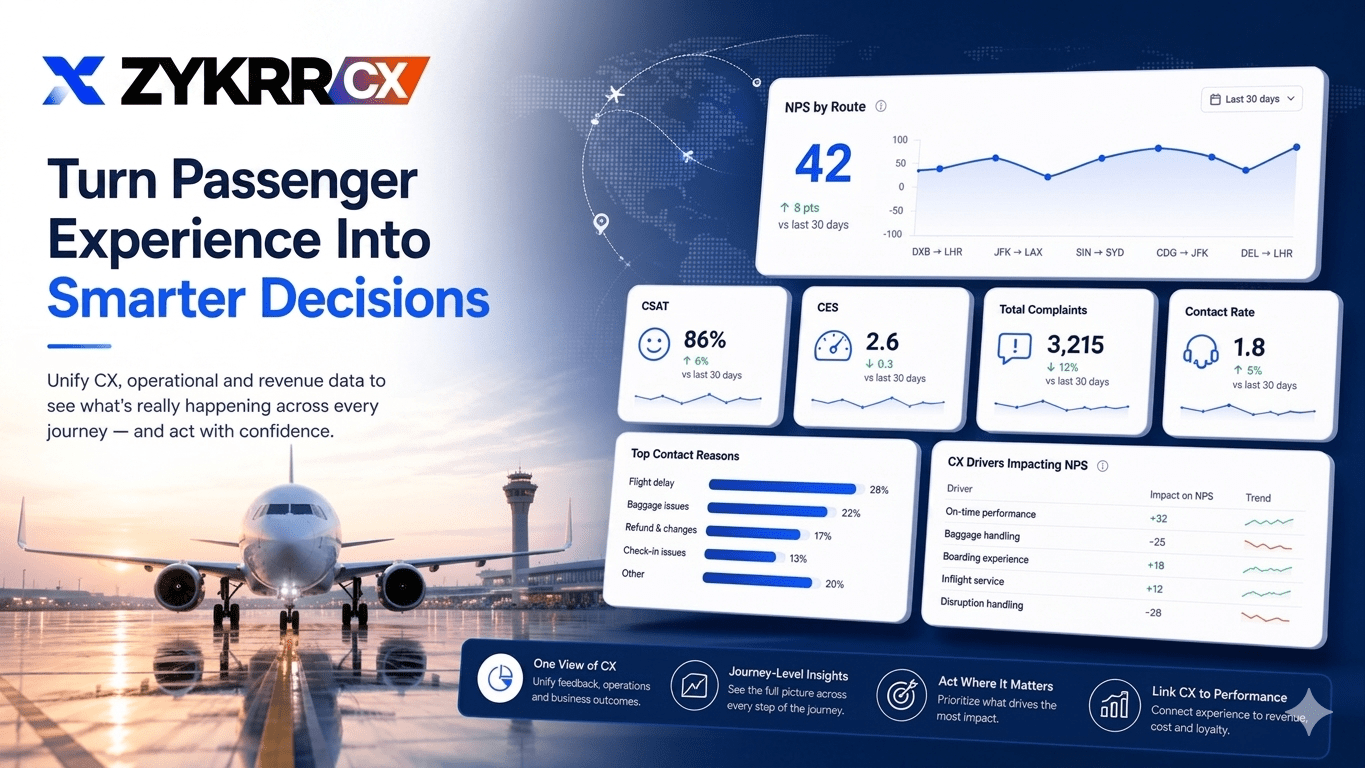
• Airline CX analytics: It should connect NPS, CSAT, CES, delay codes, rebooking data and revenue information into dashboards and models.
• Security, privacy and scalability: It should comply with aviation data standards and regional privacy laws while handling high seasonal volumes.
An airline CX platform does all of this in one place, instead of forcing you to stitch together survey tools, spreadsheets and local workarounds.
Airline journeys every CX platform must support
Every airline is different, but the core journeys are similar across carriers. A practical way to scope an experience management project is to focus on these flows first.
Booking and planning
This includes search, fare comparison, ancillary selection and payment across direct and indirect channels.
Your CX platform should capture feedback on search usability, price transparency and payment success. It should segment pain points by channel, device and partner. And it should link booking friction to cart abandonment and call centre volume.
1. Pre travel and check in
This includes itinerary changes, check in, seat selection and baggage purchase.
Your platform should track CSAT and CES for check in across web, mobile and airport kiosks. It should identify patterns in queue times and digital drop offs. And it should flag cases like unaccompanied minors or special assistance passengers who give low satisfaction scores.
2. Airport and security experience
This includes terminal wayfinding, security and boarding.
Your platform should combine operational data like queue times and boarding delays with NPS and comments. It should surface airports and times of day with recurring experience issues. And it should feed joint improvement plans with airport partners.
3. Inflight experience
This includes crew interactions, cabin comfort, catering and inflight entertainment.
Your platform should capture structured and unstructured feedback linked to flight number, cabin and crew. It should separate product design issues from service delivery gaps. And it should give crew and inflight managers simple dashboards to spot recurring themes.
4. Disruption, irregular operations and baggage
This is where you find out if passengers will fly with you again.
Your platform should track airline delay customer experience in real time. It should capture feedback on rebooking, communication quality and compensation. And it should connect OTP and mishandled baggage metrics with NPS and revenue.
These journeys anchor your airline CX analytics and make sure your software focuses on real passenger outcomes, not vanity reports.
Measuring NPS, CSAT and CES for airlines
Surveys still matter. What changes is how you design and use them.
Use NPS, CSAT and CES together
Each metric answers a different question.
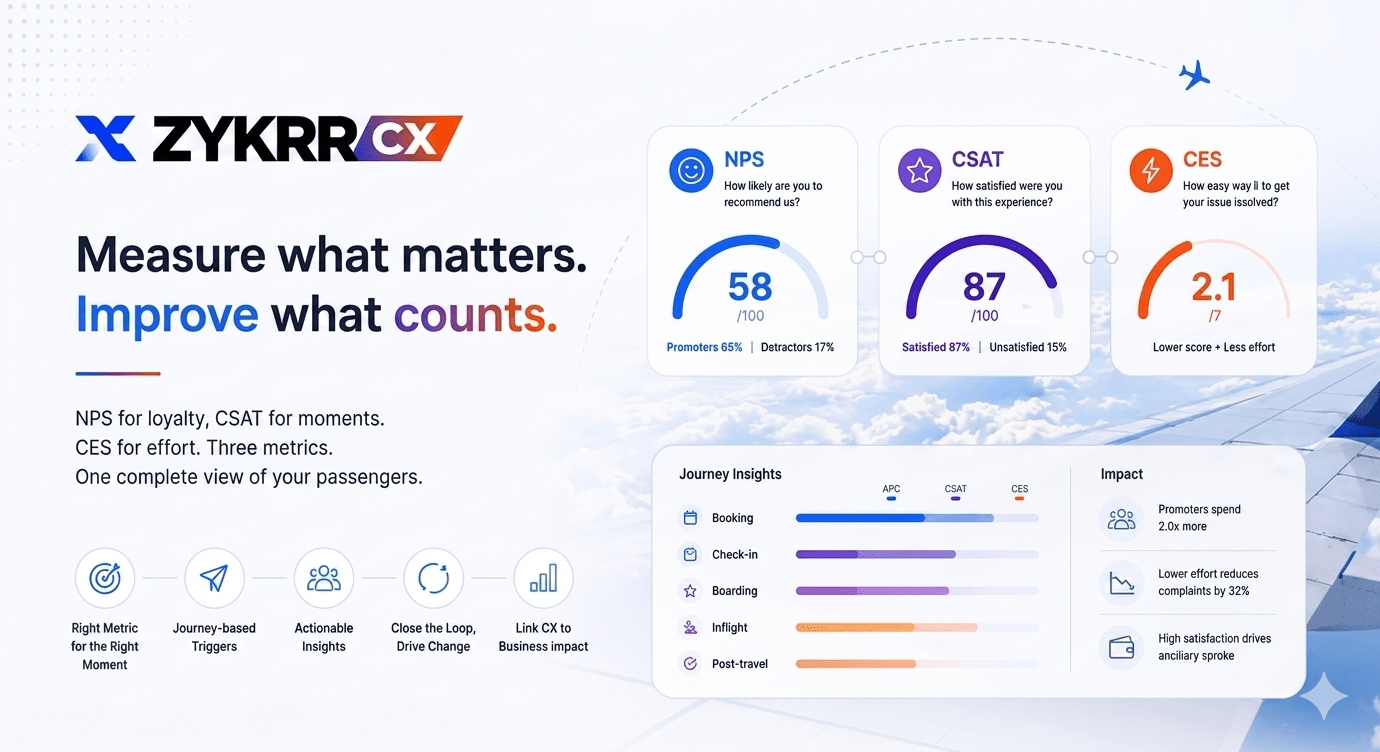
• NPS shows long term loyalty and advocacy.
• CSAT shows satisfaction with a specific interaction or journey.
• CES shows how easy it was for the passenger to do something like rebooking or changing seats.
A modern CX platform for airlines should let you run all three in context, not force you to choose one.
Trigger surveys at the right moment
Timing matters more than most airlines realise.
• Send post booking CSAT quickly while the experience is fresh.
• Trigger airport or inflight surveys based on flight completion, not arbitrary timelines.
• Trigger disruption surveys when a delay, cancellation or involuntary downgrade occurs.
• Trigger baggage surveys only after the mishandled bag claim process finishes.
This gives you clean data tied to episodes, not generic satisfaction snapshots.
Close the loop with targeted actions
Measurement without action reduces trust.
• Your platform should support automatic alerts when high value passengers give low scores.
• It should provide playbooks for agents and station managers to follow up with calls, vouchers or personalised messages.
• And it should feed root cause analysis into process change, not just individual appeasement.
This is where ZYKRR’s focus on CX monetization becomes relevant. The goal is to reduce avoidable cost, protect loyalty and unlock ancillary revenue, not just collect more data.
Airline sentiment analysis tools and unstructured feedback
Surveys tell you what you ask.
Unstructured feedback tells you what passengers care about before you think to ask.
• A solid airline sentiment analysis layer should analyse call recordings from contact centres to find friction in scripts, policies and tools.
• It should mine email, chat and social media conversations for emerging issues across airports, routes or partner airlines.
• It should group free text survey comments into themes like staff attitude, cabin comfort, baggage handling and disruption communication.
• And it should identify emotion alongside sentiment, things like frustration, relief or gratitude.
Modern LLMs can speed up this analysis significantly.
Instead of manual tagging, you can have models that summarise thousands of comments and surface patterns by route, airport, cabin or customer segment.
A platform like ZYKRR can layer LLM based airline sentiment analysis on top of NPS, CSAT and operational data so that your teams see one unified picture rather than a pile of disconnected dashboards.
How ZYKRR supports airline customer experience
Every airline will configure ZYKRR differently, but the core approach stays consistent.
Signals
ZYKRR’s signals suite captures feedback from:
• Booking and check in flows on web and mobile.
• Airport kiosks and QR codes at key touchpoints.
• Contact centre interactions across voice, chat and email.
• Social media and review sites where passengers share their stories.
This gives you near real time visibility into airline customer experience.
Intelligence
The intelligence suite brings together:
• NPS, CSAT and CES by route, cabin, airport and channel.
• Disruption metrics such as delay minutes, cancellations and misconnects.
• Baggage performance and rebooking outcomes.
• LLM powered sentiment and theme analysis across calls and comments.
You can see which experiences drive complaints, churn and negative word of mouth, and which experiences build loyalty.
Actions
The actions suite makes CX change operational.
• It converts low scores, complaints and high risk journeys into cases with owners and due dates.
• It provides escalation paths for premium passengers, corporate accounts and vulnerable travellers.
• And it helps stations, crew managers and contact centre leaders track their backlog and resolution performance.
Monetization
The monetization layer links experience improvements to financial outcomes.
• It ties CX signals to churn, repeat purchase and ancillary uptake.
• It estimates risk to future revenue when poor experiences hit high value passengers.
• And it helps you prioritise projects and markets where experience change will pay back fastest.
This is where ZYKRR differentiates from pure airline customer experience software. The platform is built to connect CX to measurable impact, not just soft scores.
Implementation roadmap for an airline CX platform
A structured roadmap reduces risk and builds trust across functions.
Step 1: Define outcomes and journeys
Start by agreeing on three to five outcomes, for example: reduce complaints per thousand passengers, improve NPS for delayed flights by a defined margin, or reduce avoidable call volume by making digital journeys easier.
Then pick the journeys that matter most, like delay handling, baggage issues and online check in.
Step 2: Consolidate signals
Integrate existing surveys, contact centre data, app events and basic operational metrics into one view.
The goal is not perfect data on day one. It is visibility across journeys that you can iterate on.
Step 3: Roll out listening and case management
Refine surveys, triggers and airline CX analytics dashboards.
• Set up case workflows so that low scores and critical comments do not sit ignored in an inbox.
• Train frontline teams on when and how to follow up.
• Create simple scorecards for stations and hubs.
Step 4: Add LLM and sentiment intelligence
Once you have steady flows of structured data introduce:
• LLM based summarisation of call transcripts and survey comments.
• Add automatic theme grouping by route, airport and cabin.
• Build suggested responses and playbooks for agents to use when contacting customers.
This makes it realistic to handle large feedback volumes without expanding analyst headcount.
Step 5: Connect CX to revenue and cost
Finally, link CX data with revenue, loyalty and operational cost.
• Quantify how better disruption handling reduces compensation disputes and repeat contacts.
• Explore how premium customers with low NPS behave over the next twelve months.
• Identify where experience improvements can support ancillary revenue from things like baggage, seat upgrades and lounge access.
This step turns CX from something you report on into something that pays for itself.
LLM prompt ideas for airline CX teams
You can embed a small “LLM helper” block on this page so that airline teams know exactly how to use models like ZYVA or other LLMs with their own data.
Sample prompts:
1. “You are an airline CX analyst. Summarise these NPS and CSAT comments for flight delays on our top ten routes. Group them into themes and suggest three root causes per theme.”
2. “You are a contact centre quality leader for an airline. Analyse these call transcripts about baggage delays. Identify policy problems, script issues and training gaps.”
3. “You are a product manager for mobile check in. Review these app reviews and survey comments and list the top five UX issues that block passengers from completing check in.”
4. “You are an airline revenue manager. Combine this CX data with route profitability and highlight where poor experience is most likely to hurt revenue next quarter.”
5. “You are a station manager at a hub airport. Read these comments about our boarding process and suggest three quick experiments we can run in the next month.”
You can position ZYVA as the LLM layer that is tuned for CX data and integrated into the ZYKRR platform.
Frequently
Asked Questions
-


What is airline customer experience software?
Airline customer experience software is a platform that collects passenger feedback, operational data and interaction history across channels, then turns that data into insights and actions. It supports surveys, journey analytics, sentiment analysis and case management tailored to airline journeys.
-
How is an airline CX platform different from a generic survey tool?
A generic survey tool can send forms and store responses. An airline CX platform connects those responses to specific flights, passengers, routes and disruption events. It also integrates call centre, app and operational data, supports closed loop actions and connects experience metrics with revenue and loyalty.
-
Which CX metrics matter most for airlines?
NPS, CSAT and CES all matter, but they work best when tied to journeys. For example, CSAT for check in, CES for disruption rebooking and NPS for the overall trip. Airlines also need to connect these metrics with OTP, mishandled baggage rates, complaints and repeat purchase behaviour.
-
Where should an airline start if it has no CX platform today?
Start with one or two journeys that cause the most pain, like delay handling and baggage recovery. Consolidate existing feedback and operational data for those journeys, roll out improved surveys and basic case management, then gradually extend the platform to other journeys and regions.
-
Can smaller airlines justify investing in CX software?
Yes, but the scope should be right sized. A regional carrier may not need every feature on day one. Even a focused implementation that improves disruption communication, reduces complaints and protects high value passengers can pay back quickly in loyalty and reduced cost to serve.